


Zapopan. The City That Can Turn the World Cup Into Urban Legacy
- Editorial

- Jun 5
- 3 min read

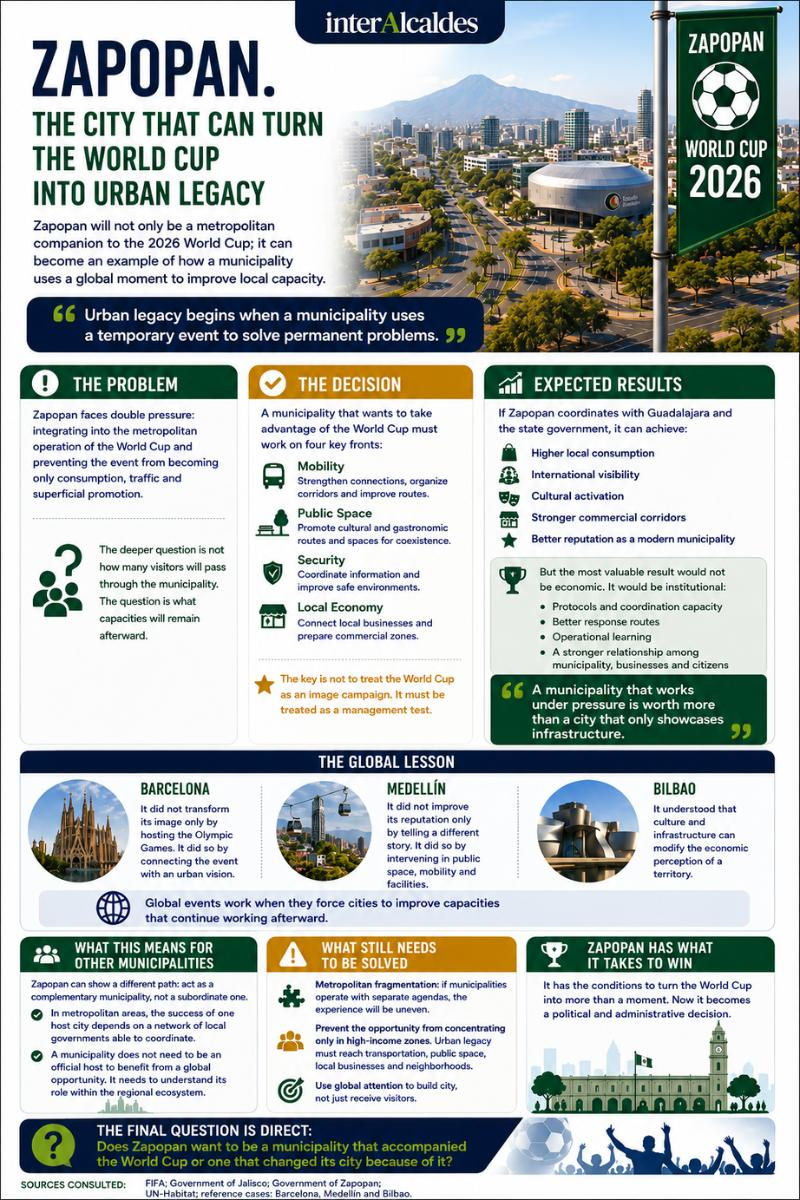
Zapopan will not only be a metropolitan companion to the 2026 World Cup; it can become an example of how a municipality uses a global moment to improve local capacity.
Zapopan faces a larger opportunity than receiving visitors during the 2026 World Cup: it can prove that a metropolitan municipality can turn a global event into urban legacy.
The conversation usually focuses on Guadalajara as the host city. But in practice, the World Cup experience will be metropolitan. Lodging, consumption, mobility, entertainment, commercial corridors and cultural activities will extend toward Zapopan. That places the municipality in a strategic position: it is not the formal stage of the spectacle, but it can be a key piece of urban performance.
Zapopan does not arrive without advantages. It is one of Jalisco's most economically relevant municipalities, with business districts, universities, shopping centers, cultural spaces and a broad service base. It also faces the tensions of a fast-growing city: mobility, territorial inequality, real estate pressure, security and public services.
"Urban legacy begins when a municipality uses a temporary event to solve permanent problems."
You can listen to this article here:
The problem
Major events often create a dangerous illusion: believing that global attention equals transformation. It does not. Transformation depends on local decisions.
Zapopan will face double pressure. On one hand, it must integrate into the metropolitan operation of the World Cup. On the other, it must prevent the event from becoming only consumption, traffic and superficial promotion.
The deeper question is not how many visitors will pass through the municipality. The question is what capacities will remain after they leave.
The decision
A municipality that wants to use the World Cup must work on four fronts: mobility, public space, security and the local economy.
Zapopan can strengthen connections with Guadalajara, organize high-traffic corridors, promote cultural and gastronomic routes, prepare commercial areas, coordinate tourism information and connect local businesses with the World Cup opportunity. It can also use the event as a reason to accelerate improvements residents already need.
The key is not to treat the World Cup as an image campaign. It must be treated as a management test.
Expected results
If Zapopan coordinates with Guadalajara and the state government, it can capture important benefits: higher local consumption, international promotion, cultural activation, stronger commercial corridors and a better reputation as a modern municipality.
But the most valuable result would not be economic. It would be institutional. A well-managed World Cup can leave protocols, coordination capacity, better response routes, operational learning and a stronger relationship among the municipality, businesses and citizens.
"A municipality that works under pressure is worth more than a city that only showcases infrastructure."
You can see this article here:
The global lesson
Barcelona did not transform its image simply by hosting the Olympic Games. It did so because it connected the event to an urban vision. Medellin did not improve its reputation only by telling a different story. It did so by intervening in public space, mobility and urban facilities.
Zapopan can learn from those cases without copying their scale. The principle is clear: global events are useful when they force cities to improve capacities that continue working afterward.
What this means for other municipalities
Many Mexican municipalities will be indirect spectators of the World Cup. Zapopan can show a different path: acting as a complementary municipality, not a subordinate one. In metropolitan areas, the success of a host city does not depend on one city hall. It depends on a network of local governments able to coordinate.
For other mayors, the lesson is useful: a municipality does not need to be an official host to benefit from a global opportunity. It needs to understand its role within the regional ecosystem.
What remains unresolved
The main risk is metropolitan fragmentation. If Guadalajara, Zapopan and other municipalities operate with separate agendas, the experience will be uneven.
It is also necessary to ensure that the opportunity does not concentrate in high-income areas. Urban legacy must touch transportation, public space, local businesses and neighborhoods that are usually excluded from major showcases.
Zapopan has the conditions to turn the World Cup into more than a moment. But that will depend on a political and administrative decision: using global attention to build city.
The final question is direct: does Zapopan want to be a municipality that accompanied the World Cup, or one that used the World Cup to function better?

Written by: Editorial
Sources Consulted
Zapopan Municipal Government, public institutional information.
Government of Jalisco, public information on metropolitan coordination.
FIFA, official information on the 2026 World Cup.
UN-Habitat, analysis on metropolitan areas and public space.
Reference cases: Barcelona and Medellin.
interAlcaldes editorial analysis.


Comments