


Municipalities Without Water. The Economic Cost of Governing Only for the Short Term
- Editorial

- Jun 16
- 4 min read
The water crisis is no longer a problem of pipes alone: it now defines which municipalities can attract investment, organize housing, protect public health and remain viable.
Water Has Entered the Municipal Balance Sheet
A municipality can inaugurate streets, announce investment, approve new subdivisions and boast about urban growth. But if it cannot guarantee water, every other promise becomes fragile. The water crisis is no longer a technical matter hidden inside local utilities; it is now an economic variable that determines land value, the cost of living, industrial viability and public trust.
The failure of governing only for the short term begins when water is managed as an emergency instead of strategic infrastructure. The leak is fixed only after it breaks the street, tanker trucks arrive when a neighborhood protests, another well is drilled without a serious conversation about recharge, housing is approved without measuring future demand and investment is promoted without showing water capacity. Under that logic, the municipality does not plan; it reacts.
“A municipality without water does not only manage scarcity: it manages lost investment, lost trust and a lost future.”
You can listen to this article here:
Without Water, Investment Becomes More Expensive
The global picture confirms that water is now a competitiveness criterion. The United Nations estimates that in 2024, 2.2 billion people still lacked safely managed drinking water services, while the World Resources Institute warns that around 4 billion people live under high water stress for at least one month a year. The message for Mexico is clear: water is no longer only an environmental indicator; it is a minimum condition for production, housing and governance.
In Mexico, that pressure lands directly at the municipal level. Article 115 of the Constitution assigns municipalities responsibility for drinking water, drainage, sewerage, wastewater treatment and disposal. When a municipality fails on water, it does not simply fail to provide a service; it compromises its development model. A company evaluating where to locate does not ask only about land, highways or incentives; it asks whether supply will be reliable. A hospital does not operate on speeches. A school does not function under rationing. A home loses value when it depends on tanker trucks.
Every unrepaired leak is lost water, but it is also evaporated public money. Every tanker truck hired without a structural plan is current spending disguised as a solution. Every urban permit issued without water capacity is social debt transferred to the next administration. That is the economic cost of improvisation: the municipality pays more to solve late what it should have organized earlier.

The Problem Is Not Only Drought. It Is Management
Drought matters, but it does not explain everything. Mexico's Drought Monitor reported that as of May 31, 2026, only 2.8% of the country's surface was under moderate to extreme drought, with 50 municipalities in drought and 245 abnormally dry. That figure may seem reassuring, but it reveals a more uncomfortable point: even when drought recedes, many cities remain vulnerable because the problem also lies in deteriorated networks, incomplete measurement, weak utilities and urban planning without water support.
BBVA Research, using INEGI data, documented that in 2022 there were 2.59 million households in Mexico without water pipe infrastructure, more than one million of them in urban areas. The same analysis notes that one out of three households with pipes received water through rationing. That figure dismantles the idea that having a network is enough. The economic question is different: how much it costs to operate a network that does not guarantee continuity, how much is lost through leaks, how much is actually collected and how much subsidy is hidden in a tariff that does not finance maintenance.
“The short term may win elections; water decides whether a municipality will have a future.”
You can see this article here:
The Municipal Water Assessment Will Be the New Frontier
The next municipal conversation must be the water feasibility assessment. Before authorizing housing, industrial parks, hotels, shopping centers or new subdivisions, local governments will have to demonstrate real capacity for supply, treatment, reuse and resilience. Not as paperwork to justify permits, but as a reality test: how much water exists, how much is lost, how much can be treated, how much future demand is being authorized and how much it will cost to sustain that growth.
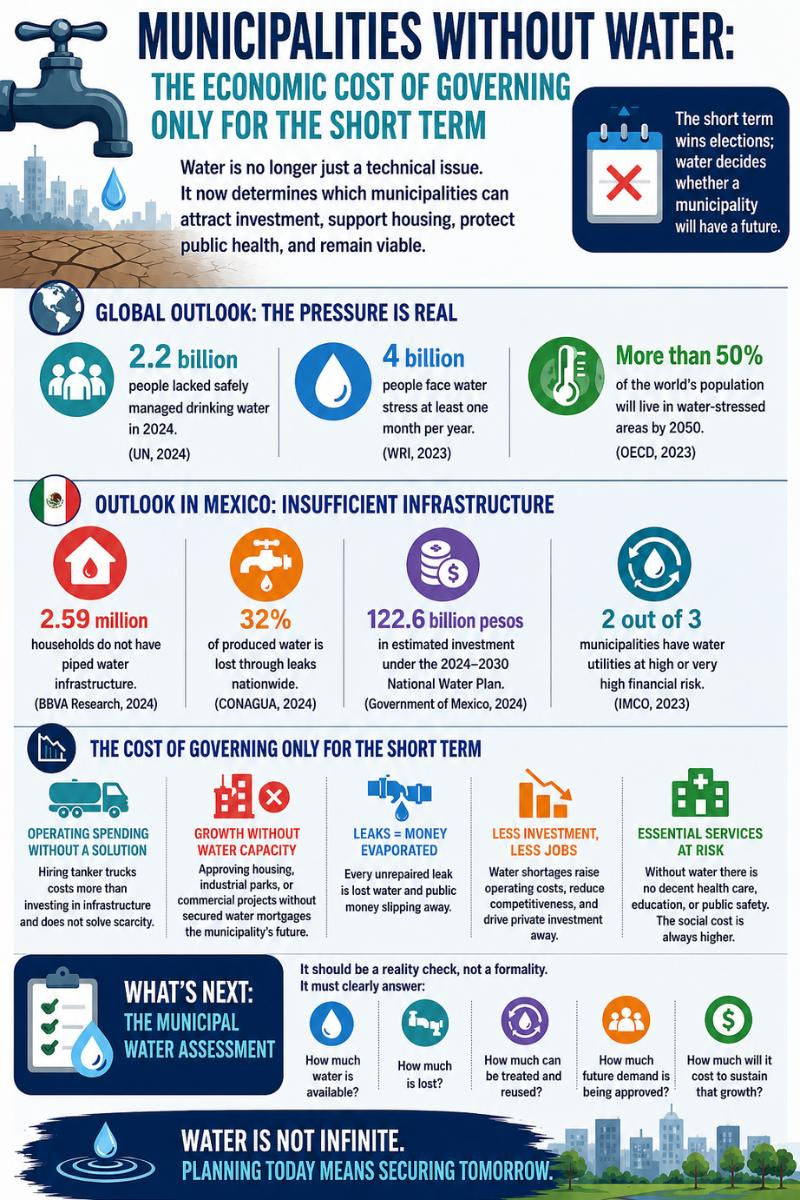
The National Water Plan 2024-2030 already places strategic projects and an estimated 122.6 billion pesos in infrastructure investment on the table, along with diagnostics and master plans for the country's 2,478 municipalities. But no national plan can replace local discipline. If the municipality does not measure, collect with social intelligence, reduce losses, make information public and connect urban permits to water capacity, money will arrive late or be absorbed by the same emergency-driven logic.
What Comes Next
Municipalities that understand this transition will have an advantage. They will be able to attract investment with evidence, organize housing responsibly, professionalize local utilities, build socially defensible tariffs, use treated water where possible and set limits where the territory can no longer bear the pressure. Those that do not will remain trapped in tanker-truck politics: visible, expensive, urgent and deeply insufficient.
The water crisis does not call for heroic speeches. It requires budgets, measurement, maintenance, urban regulation and the political courage to say no. In the municipal economy of the twenty-first century, water is not just another service. It is the first test of local viability.

Written by: Editorial


Comments