


State 33 is ready. The Mexican Diaspora Becomes a Strategic Asset for Local Governments
- Editorial

- Mar 17
- 4 min read

For decades, the Mexican diaspora was largely viewed as a source of remittances and a consular issue. That perspective is now outdated. Today, Mexico’s local governments face a far broader asset: a transnational network of talent, investment, political influence, cultural consumption, and business connections that can strengthen the country’s position with partners across the Americas, Europe, and Africa. The scale of this phenomenon speaks for itself. In 2023, 10.9 million Mexican-born individuals lived in the United States, while the broader population of Mexican origin far exceeds that figure; the National Autonomous University of Mexico (UNAM) estimates that the Mexican diaspora in the U.S. reaches 37.8 million people.
The most visible economic indicator remains striking. Mexico’s central bank reported that remittances totaled $61.79 billion in 2025; although slightly below the record $64.74 billion in 2024, they closed the year with a recovery in December of 1.9% year-over-year, and in January 2026 reached $4.59 billion. Even more revealing is that 99.1% of remittances in 2025 arrived through electronic transfers, and in January 2026, 98.6% continued to flow through this channel. This means the diaspora is already operating within a mature digital financial infrastructure. For municipalities and states, this should be understood not only as household income but as a platform for savings, co-investment, payments, financial education, and productive projects linked to local territories.

This leads to the first major political lesson: engagement with Mexicans abroad can no longer depend solely on federal diplomacy. Local governments must build their own proximity-based economic diplomacy. An exporting municipality in Jalisco, Guanajuato, Nuevo León, Puebla, or Baja California needs to map its diaspora not just through nostalgia, but through professional specialization, investment capacity, business networks, and market access. The traditional hometown association model remains useful, but it is no longer sufficient. Comparative experience from institutions such as the Migration Policy Institute shows that migrant associations have been effective in channeling resources and maintaining ties with communities of origin; the next step is to evolve toward a more sophisticated local policy that shifts from social projects to knowledge transfer, buyer attraction, and the development of binational value chains.
The trade context makes this agenda even more urgent. Mexico closed 2025 with a historic $40.87 billion in foreign direct investment, 10.8% higher than the previous year, and record trade with the United States totaling $873 billion. Around 80% of Mexican exports continue to go to the U.S. market, just as the formal review of the USMCA began in March 2026. At the same time, the European Union remains a significant partner, with €53.15 billion in exports to Mexico and €29.20 billion in imports from Mexico. In other words, the country is more internationalized but also more exposed to regulatory, tariff, and geopolitical uncertainty. In this environment, the diaspora functions as a strategic buffer: it opens business doors, reduces trust costs, and helps sustain Mexico’s presence in highly competitive global markets.

The technological dimension is perhaps the most underestimated. The Global MX Network, promoted by the Institute for Mexicans Abroad, includes around 60 chapters in nearly 30 countries and more than 6,000 highly skilled members. This network demonstrates that the diaspora is not only migrant labor but also a scientific, entrepreneurial, and executive community embedded in innovation ecosystems across North America and Europe. For local governments, this opens a concrete pathway: leveraging Mexican talent in Austin, California, Toronto, London, Paris, Berlin, or Barcelona for mentorship, technology transfer, university promotion, patents, dual education, and supplier attraction for nearshoring industries. Even engagement with Africa is taking on a new logic, as Mexico strengthened its dialogue with the African Union and expanded diplomatic, academic, and economic ties with the continent. Here too, diaspora and professional networks can serve as bridges for Mexican port, logistics, and university cities seeking new global partners.
Mexican and U.S. universities are already offering valuable insights. UNAM has documented ongoing projects addressing the mental health of the Mexican diaspora in Boston and broader initiatives for protection and engagement with communities abroad. This suggests that a modern diaspora policy cannot be limited to hard economics. It must also include health, education, culture, civic identity, and digital services. A well-supported community abroad does not only send money; it maintains territorial loyalty, participates in projects, recommends destinations, connects institutions, and amplifies the international reputation of its place of origin.
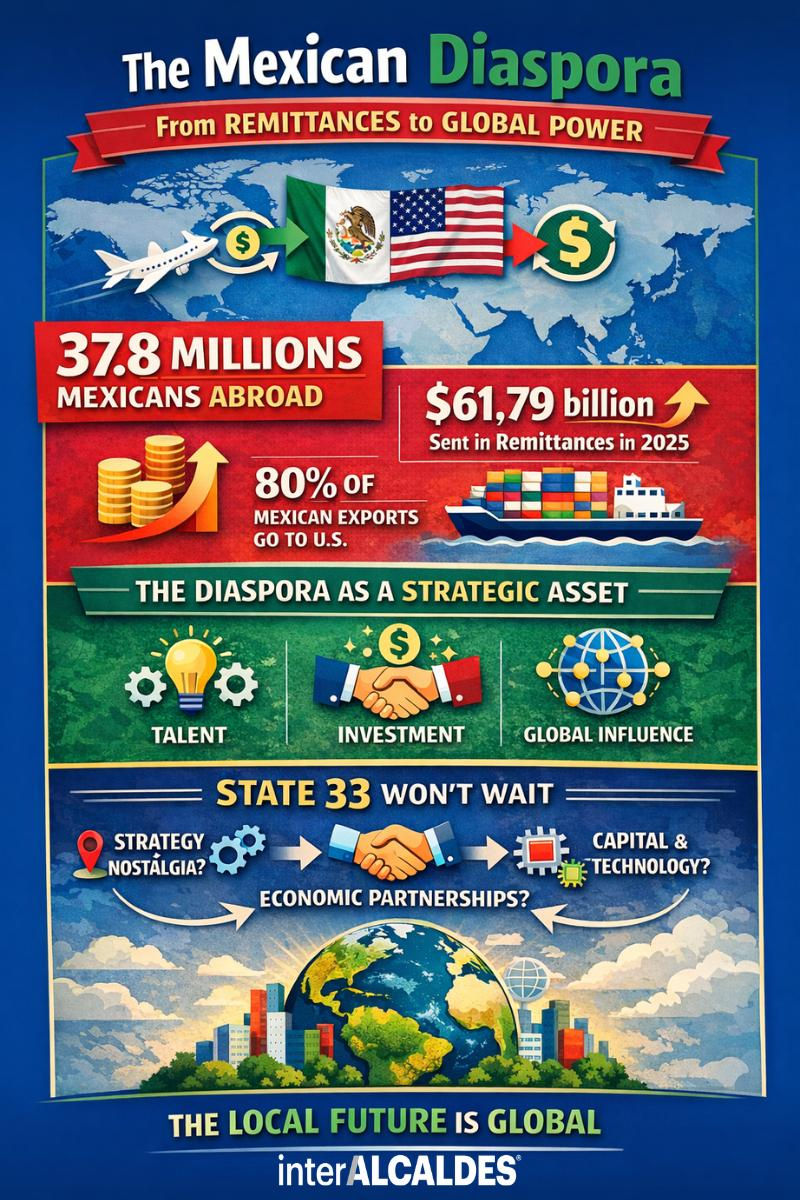
The challenge ahead is clear. Mexico cannot afford to rely solely on remittance inflows while other countries transform their diasporas into industrial, scientific, and diplomatic engines. Local governments must develop intelligent registries of migrant talent, binational economic liaison offices, partnerships with consulates and universities, co-investment portfolios, and metrics that measure returns beyond remittance volumes. At the same time, they must confront real risks: increasing migration pressures in the United States, uncertainty surrounding the USMCA review, slower economic growth, insufficient infrastructure, and the political temptation to treat the diaspora as a symbolic campaign tool rather than a development partner. If this inertia persists, Mexico will continue to have a powerful yet underutilized diaspora. If it changes, the State 33 could become the most dynamic partner in local development.
At interAlcaldes, we want to hear from you: does your municipality still see Mexicans abroad as remittance senders, or as strategic partners in development? Share your thoughts and join the conversation on how to transform the diaspora into a next-generation local policy.

Written by: Editorial


Comments