


The 2030 Agenda Is Breaking Down… and Cities Will Pay the Price in 2026
- Editorial

- Feb 17
- 3 min read

By 2026, simply declaring “commitment” to the 2030 Agenda is no longer enough. The global conversation has shifted from promises to execution, from alignment to measurable outcomes—and inconsistency is now penalized. In this landscape, Mexican cities—and their counterparts across the Americas, Europe, and Africa—face an uncomfortable truth: the multilateral agenda is being decided in cities, yet many local capacities remain too weak to translate global goals into infrastructure, services, and jobs.
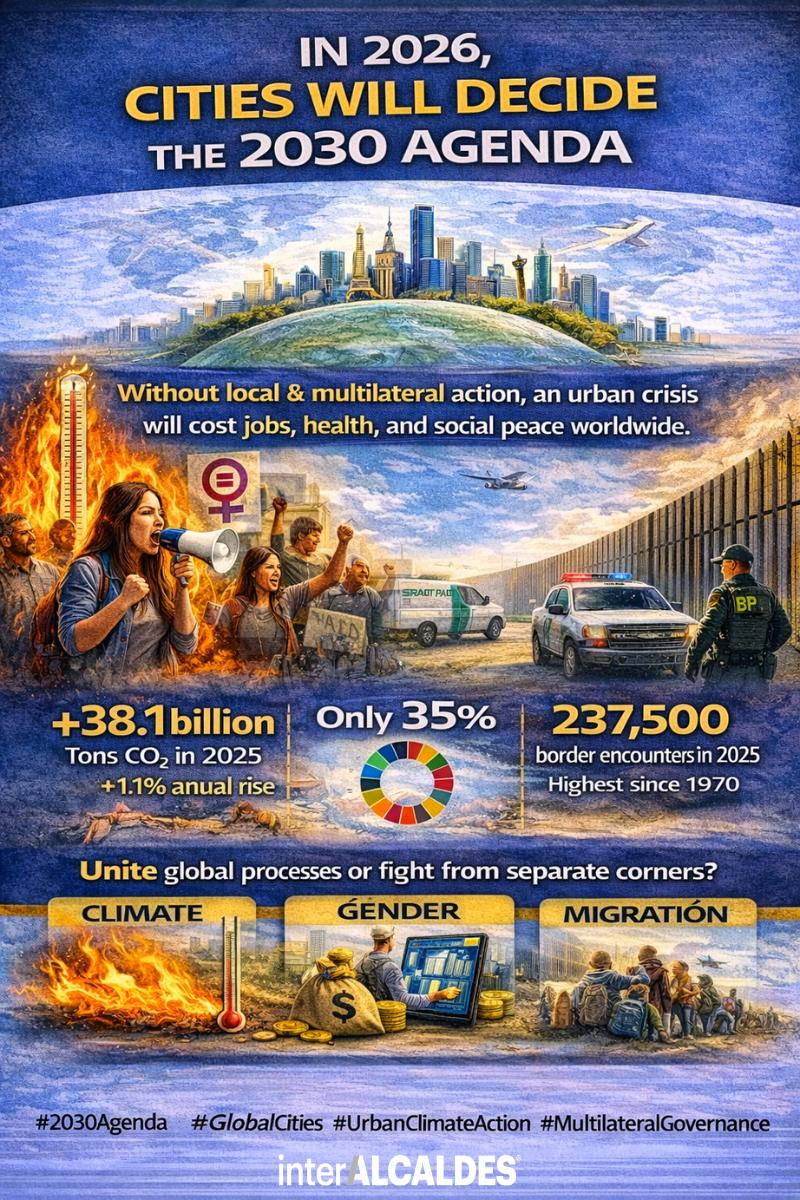
The evidence from 2025 is stark. The UN Sustainable Development Goals Report 2025 found that only 35% of targets are on track or showing moderate progress; nearly half are advancing too slowly, and some are moving backward. This matters for local politics because, according to the OECD, at least 105 of the 169 SDG targets require direct action by subnational governments, which also account for roughly 55% of public investment in OECD countries. In short: if cities don’t execute, the 2030 Agenda doesn’t happen.
Multilateralism is no longer the exclusive domain of foreign ministries. Today, networks of cities and local governments—formally and informally—sit at the global table on climate, financing, resilience, mobility, public health, digitalization, and rights. The reason is pragmatic: legitimacy is built where people live. In 2026, Mexico’s trading partners in North America and Europe, along with emerging markets in Africa, are aligning investment, procurement, and cooperation to sustainability, traceability, and governance standards. Cities that fail to meet them lose competitiveness.

The 2030 Agenda goes far beyond SDG 11 (cities). It encompasses water, energy, jobs, education, health, food security, inequality, and social peace—each with a strong municipal component. When the UN reports global stagnation, the impact lands locally: tighter fiscal space, higher social pressure, and rising infrastructure demands. The response must be territorial planning with indicators—not narrative alignment, but executable targets such as water-loss reduction, energy efficiency, public transport upgrades, urban regularization, digital permitting, and procurement aligned with ESG criteria.
Climate has become the variable reshaping budgets. In 2025, global fossil-fuel CO₂ emissions reached 38.1 billion tons, a 1.1% annual increase, while the year ranked among the hottest on record. For cities, this translates into more heat waves, water stress, wildfires, and higher insurance and infrastructure costs.
There is, however, evidence that cities can close part of the gap. C40 reports that 73% of its cities have already peaked emissions, and that meeting urban commitments could close up to 37% of the ambition gap toward 1.5°C by 2030. For Mexico in 2026, this means two binational priorities: adaptation (water, storm drainage, health) and clean industrial competitiveness (energy, freight mobility, land-use planning), as North American markets tighten compliance and footprint requirements.

The global agenda has internalized a hard truth: there is no development without equality. UN Women’s Gender Snapshot 2025 shows progress alongside backlash and resistance, framing underinvestment in equality as a macroeconomic and social risk. For local governments, this is not rhetoric—it translates into gender-responsive budgets, urban safety, safe transport, care systems, and digital access. In Europe, these metrics already condition cooperation and financing. In parts of Africa, equality is increasingly linked to climate resilience and social stability.
Migration has reshaped urban governance in Mexico and the United States. In fiscal year 2025 (October 2024–September 2025), U.S. Border Patrol recorded 237,538 encounters, the lowest level since 1970, marking a sharp shift from prior years. At the same time, IOM surveys in 2025 showed that nearly 50% of migrants in Mexico considered the country a destination—up from under 25% previously—signaling that many Mexican cities are no longer just transit points but places of settlement and service provision.
For 2026, the binational challenge is clear: without local–federal–consular coordination, migration strains housing, health systems, informal employment, and community safety. Effective international cooperation here finances capacity—shelters meeting standards, labor integration, skills certification, data interoperability, and metropolitan coordination.
For mayors, the question is no longer whether to attend forums, but whether they return with projects. COPs, networks such as C40 and ICLEI, and urban development forums are instruments to secure financing, technology transfer, and university partnerships. In 2026, effective participation requires ready dossiers: project pipelines, emissions accounting, adaptation plans, data governance, and transparency mechanisms to avoid “photo-op diplomacy.”
That 2026’s potential hinges on three fronts.
First, municipal technical capacity: without teams and data, the 2030 Agenda remains a slide deck.
Second, financing and execution: climate pressure demands better spending, not just more spending.
Third, binational coherence: Mexico and the United States share supply chains and climate risks; if their cities fail to coordinate standards, permitting, energy, and talent, they will lose investment to more orderly regions in the Americas and Europe—and to emerging hubs in Africa.
The 2030 Agenda will not be “saved” in 2030. It will be decided in 2026—street by street, project by project, data point by data point.

Written by: Editorial


Comments