


Sports Tourism. The Economic Impact Only Prepared Cities Will Capture
- Editorial

- Jun 2
- 3 min read

The 2026 World Cup may generate economic movement, but only municipalities with strategy will capture value beyond hotels and stadiums.
Sports tourism does not reward cities that merely receive visitors. It rewards cities that know how to turn visitors into local economic value.
The 2026 World Cup will open an exceptional window for Mexico, but that window will not automatically translate into prosperity. Economic impact does not fall evenly. It concentrates where there are connected hotels, safe corridors, efficient transportation, prepared businesses, cultural experiences and a local authority capable of managing people flows.
Mexico will host 13 World Cup matches in three cities. The 2026 edition will bring together 48 teams and 104 matches across 16 North American host cities. The difference between a host city that captures value and one that merely receives crowds will lie in municipal capacity to design an experience, not just logistics.
"Tourists do not remember the event's organizational chart; they remember whether the city worked."
You can listen to this article here:
Economic impact is not automatic
Speaking about economic impact without speaking about local distribution is an elegant way to avoid the real issue. A visitor may spend money on international lodging, digital platforms, global chains and private transportation without truly touching small businesses in the city.
The challenge for Guadalajara, Mexico City and Monterrey will not be only to fill hotel rooms. It will be to ensure that restaurants, markets, bars, guides, artisans, taxi drivers, cultural operators and neighborhood businesses are included in the World Cup economy.
That requires local policy: tourism signage, walkable routes, digital maps, neighborhood promotion, extended hours, basic visitor-service training, coordination with business chambers and security mechanisms that do not suffocate urban life.

The global lesson
Cities that best use major events do not improvise. London 2012 worked on the concept of urban legacy before the opening ceremony. Barcelona turned the Olympic Games into a repositioning platform. Medellin learned that reputation, mobility and public space are also tourism assets.
Mexico often thinks about tourism through promotion. But modern tourism requires territorial management. A campaign can attract visitors; a bad experience can drive them away forever.
During the World Cup, every route will be an evaluation: airport-hotel, hotel-stadium, stadium-restaurant, restaurant-historic district. If that chain fails, the city brand deteriorates.
What this means for municipalities
For mayors, sports tourism must be understood as local economic policy. It is not enough to wait for fans to arrive. Cities must be prepared to capture value.
A municipality can create temporary gastronomic corridors, strengthen public markets, promote cultural festivals, organize commerce in high-traffic areas and provide multilingual information. It can also miss the opportunity and become a simple transit point.
The difference will be coordination. Tourism, security, mobility, economic development, culture, civil protection and communications will have to work as one system. Visitors do not distinguish departments. They only know whether a city is clear, safe and memorable.
"Economic impact is not decreed; it is designed from the territory."
You can see this article here:
What remains unresolved
The greatest risk is that benefits concentrate among a few actors. If spending remains in hotels, major restaurants and platforms, the World Cup will leave attractive figures but limited community impact.
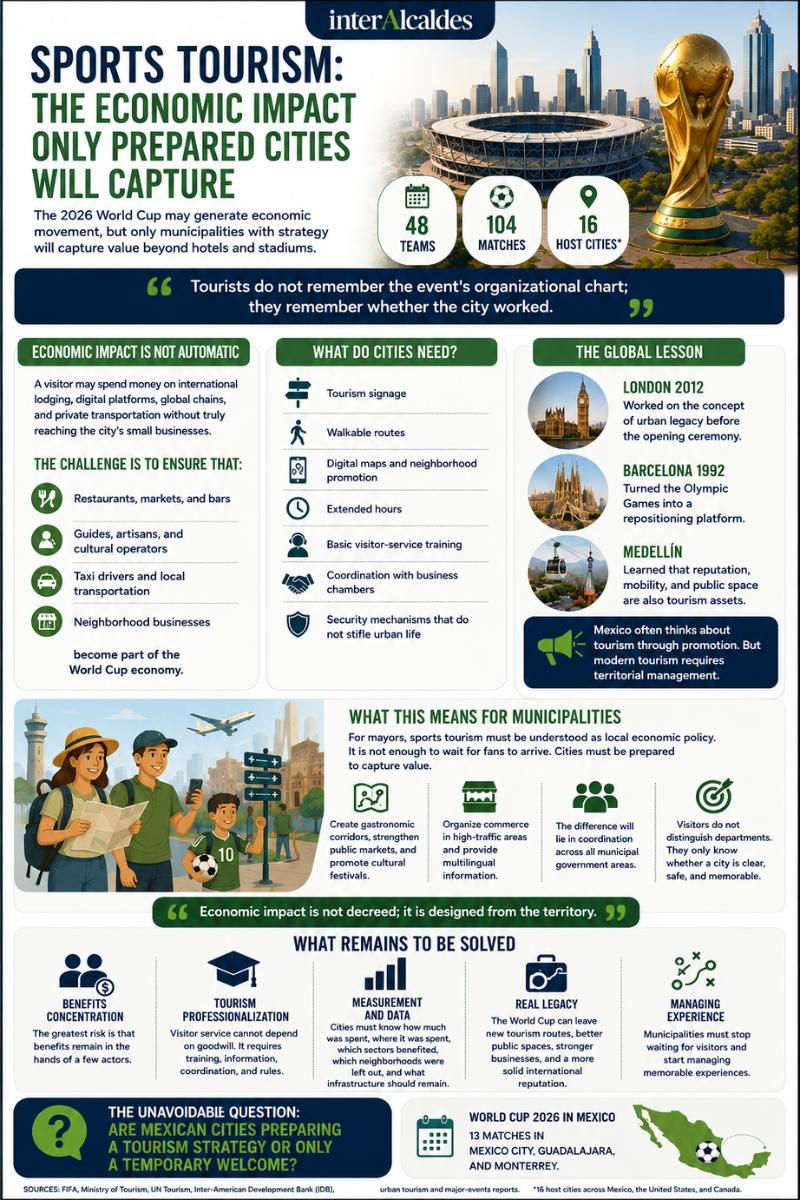
Municipal tourism professionalization is another pending issue. Visitor service cannot depend on goodwill. It requires training, information, coordination and rules.
Measurement is also missing. Cities must know how much was spent, where it was spent, which sectors benefited, which neighborhoods were excluded and which infrastructure should remain.
The World Cup can leave much more than hotel occupancy. It can leave new tourism routes, better public spaces, stronger businesses and a more solid international reputation. But that will only happen if municipalities stop waiting for visitors and start managing experience.
The unavoidable question is this: are Mexican cities preparing a tourism strategy, or only a temporary welcome?

Written by: Editorial
Sources Consulted
· FIFA, match schedule and host cities for the 2026 World Cup.
· Mexico Ministry of Tourism, public information on tourism and sports events.
· UN Tourism, analysis on urban tourism and major events.
· Inter-American Development Bank, studies on local economies and cities.
· Reference cases: London 2012, Barcelona 1992 and Medellin.
· interAlcaldes editorial analysis.


Comments