


Scanner or chaos. How to shield Mexico–U.S. trade routes and win the war against smuggling without stopping nearshoring
- Editorial

- Sep 3, 2025
- 3 min read

2025 has held up a mirror: the border can be either a bottleneck or a multiplier of competitiveness. Nearshoring continues to drive momentum, but so do risks—synthetic drug smuggling, human trafficking, cargo theft, and political volatility that already showed its sharp edge with tariff episodes that froze flows in the Juárez–El Paso corridor. The message is clear: without intelligent, binational security, North America’s most important trade corridor remains vulnerable to shocks that cost jobs and credibility.
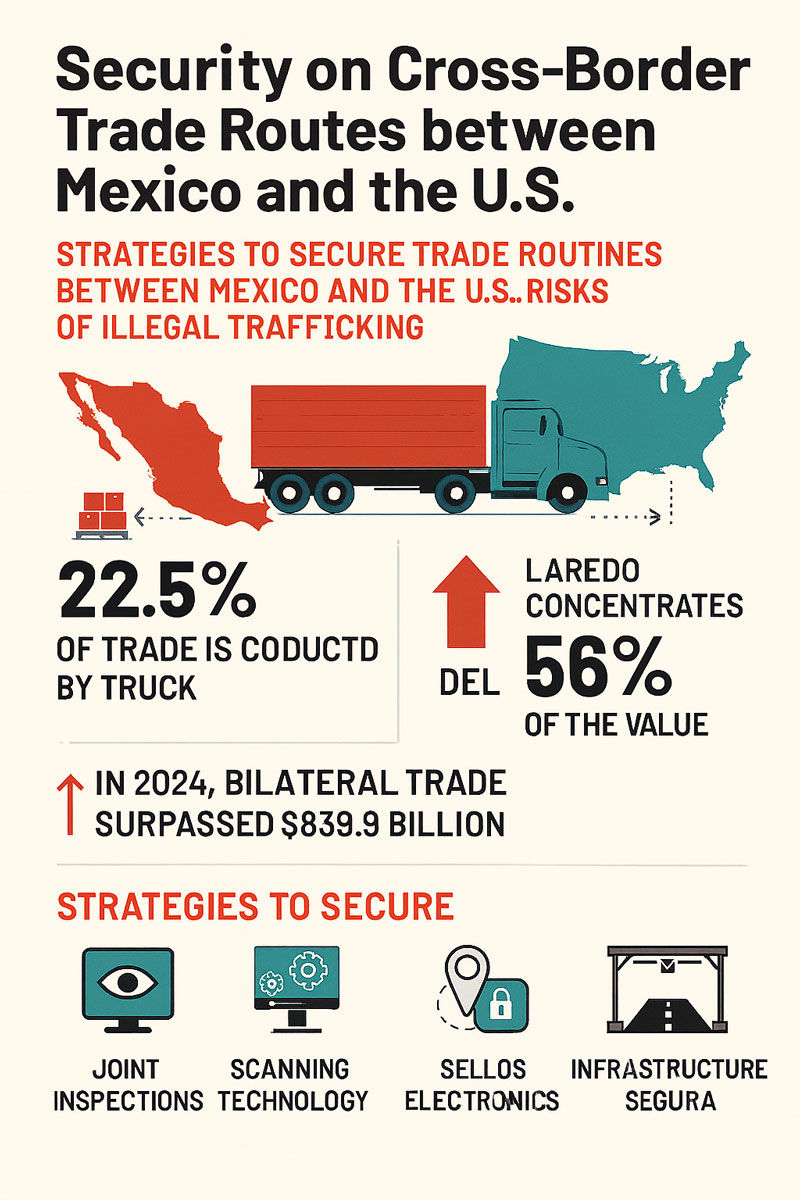
The starting point is clear. In 2024, trade in goods between the U.S. and Mexico reached $839.9 billion, a 5.1% increase compared to 2023, with 72.5% of that value moved by truck. Across North America, surface transportation (truck + rail) carried 77.1% of the total trade value; U.S. trade with Canada and Mexico totaled $1.6 trillion, representing 30% of all U.S. trade.
Texas is the backbone of that corridor, and Laredo its logistical heart. More than six out of ten commercial trucks that crossed the Texas–Mexico border in 2024 passed through the Laredo region; northbound alone accounted for 3,358,578cargo truck crossings. In value, the Laredo region moved $380.3 billion and the Port of Laredo $331.2 billion, equivalent to 56.3% of Texas–Mexico trade.
The security challenge is both real and measurable. CBP reported 1,314 pounds of fentanyl seized in November 2024, proof of sustained pressure at ports of entry. But technology deployment is still underperforming: a June 2025 DHS Inspector General audit found that of 150 non-intrusive inspection (NII) systems purchased between 2020–2024, only 50were installed, and 46% of those installed experienced long outages. The urgent task is accelerating deployment and maintenance if we want to scan more without stopping the flow.

So, what works, and how can we scale it without choking trade?
Scan smarter, not just more (risk management + NII + analytics). The goal isn’t to “check everything at any cost,” but to prioritize by risk with pre-arrival intelligence (images and manifests) and “green lanes” for trusted profiles. The DHS audit makes clear that the bottleneck isn’t buying equipment, but deploying, operating, and maintaining it. Integrating analytics and binational performance standards would allow higher inspection rates without punishing productivity.
Expand joint inspections and the Trusted Trader ecosystem. The Unified Cargo Processing (UCP) program—CBP and Mexican customs inspecting together—has proven that security and efficiency can go hand in hand; but it remains limited to select crossings. Expanding UCP and consolidating CTPAT/AEO (mutual recognition and fewer exams for low-risk companies) is the most cost-effective way to secure the chain without suffocating it.
Electronic seals and in-transit traceability. Mexico updated its electronic seal (GPS/e-seals) guidelines for domestic and transit shipments in 2024, a key tool against cargo theft and diversions. Widespread adoption and interoperable data sharing with the U.S. would add a “continuous custody layer” from origin to entry port.
Infrastructure designed for security. Modernizing ports with dedicated lanes, inspection yards outside urban areas, and technology packages (readers, scanners, telemetry) reduces the friction between security and flow. Projects like Otay Mesa East—funded through joint investment and federal donations—are built specifically around security + mobilityand should be replicated across the corridor.
What did 2024 show in measurable progress?
Trade between the U.S. and Mexico grew 5.1%, consolidating the dominance of trucks (72.5%); Texas processed >70% of that trade, and Laredo maintained its hub status with 56.3% of Texas’s total value. Operationally, Laredo concentrated >60% of Texas’s truck cargo crossings, a logistical density that demands investments in remote inspections, pre-check yards, and FAST lanes. Security-wise, rising seizures confirmed the shift of risk toward ports of entry, validating the push for NII and risk profiling. Governance-wise, academic estimates (Atlantic Council–UTEP–COLEF) suggest that cutting wait times by 10 minutes would generate 18,000 jobsin Mexico and $312 million in annual added value in the U.S.—the clearest proof that security and efficiency go hand in hand.
The 2025 challenges: realism and binationality.
First, deploy and operate the NII systems already purchased, with enforceable maintenance contracts and utilization targets by port.
Second, shield certainty against political shocks: tariff episodes in March showed that regulatory risk is now a security factor.
Third, border governance: reactivate forums like the Border Governors Conference to align protocols, data, and standards in real time (wait times, inspection rates, incidents).
Fourth, scale and coverage: extend UCP, AEO/CTPAT, and electronic seals beyond flagship ports and close the gaps at mid-sized crossings exploited by organized crime. And above all, measure: security that isn’t measured doesn’t improve.
Securing trade routes is not a dilemma between safety and growth: intelligent security is nearshoring’s industrial policy. If 2025 delivers more scanners in service, more joint inspections, and end-to-end traceability, the border will stop being a risk and become a competitive advantage for municipalities and businesses on both sides.

Written by: Editorial


Comments