


Organizing the territory. The municipal decision that can attract or scare away investment
- Editorial

- Jun 9
- 5 min read

In the new competition for productive capital, the municipality that governs its land sells certainty. The one that improvises sells risk.
Investment does not land on a blank map
Mexico may have trade agreements, geographic proximity and a powerful nearshoring narrative, but investment does not land in speeches. It lands on parcels of land, roads, permits, energy, water, housing, legal certainty and response times. That is where the uncomfortable truth begins: many municipalities want to attract capital, but they have not always organized the territory where that capital would have to operate.
The competition is no longer only between countries. It is now between municipalities capable of telling a company where it can operate, under what rules, with what available infrastructure and with what environmental, social and urban risks. In that conversation, land-use planning has stopped being a technical document for urban planners. It has become a signal of economic trust.
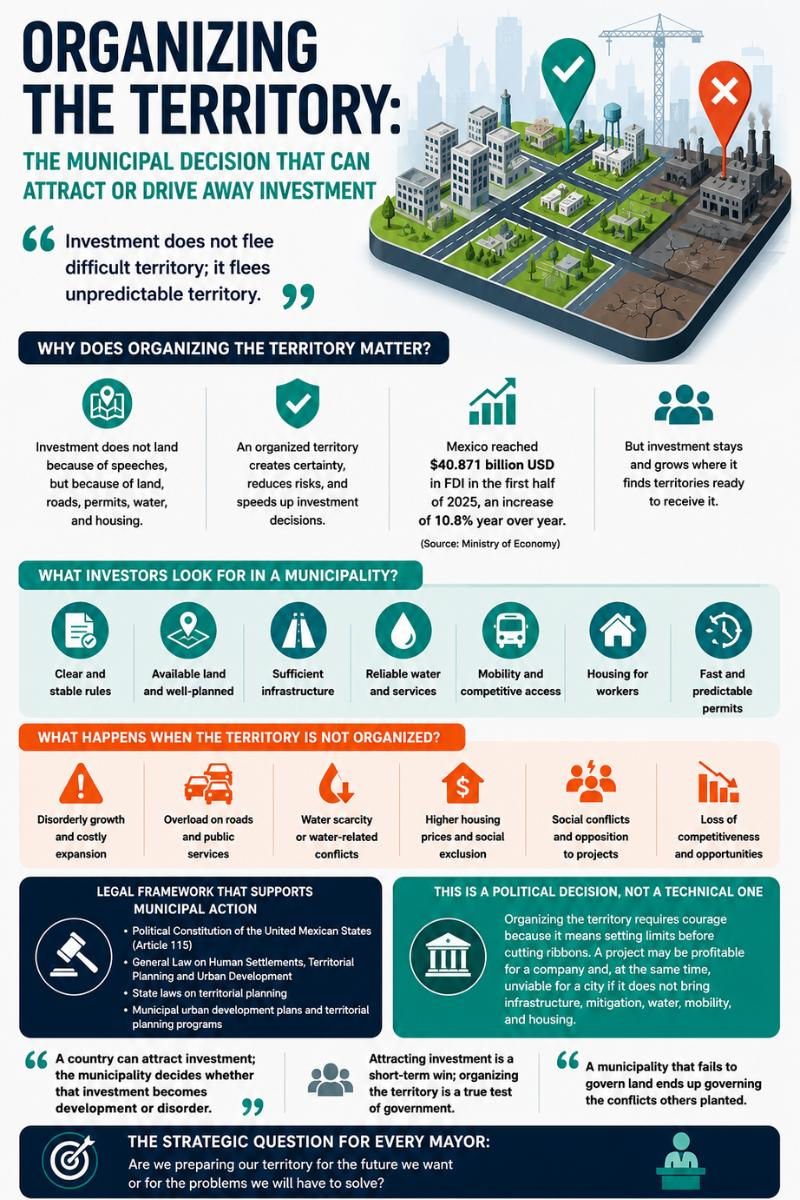
Mexico closed 2025 with 40.871 billion dollars in foreign direct investment, a record figure according to the Ministry of Economy. But that national number hides a municipal question: which territories are prepared to absorb investment without collapsing public services, mobility, housing and water?
“A country can attract investment; the municipality decides whether that investment becomes development or disorder.”
You can listen to this article here:
A company deciding where to place a plant, a logistics center, an industrial warehouse or a tourism development does not only ask about incentives. It asks about certainty. It wants to know whether the land use is compatible, whether there is conflict with communities, whether road access works, whether territorial reserves exist, whether the municipality has management capacity and whether urban expansion will end up making operations more expensive.
The problem is that too many Mexican cities grew first and planned later. Housing expansion became disconnected from jobs. Industrial parks were located far from workers’ homes. Roads were saturated before they were expanded. Agricultural areas came under real estate pressure. And permits, instead of becoming a clear route, often turned into a case-by-case negotiation. That is where trust breaks.
“Investment does not flee difficult territory; it flees unpredictable territory.”
The municipality decides before the investor does
Mexico’s General Law on Human Settlements, Territorial Planning and Urban Development recognizes that territorial planning is a shared responsibility of the federal government, states and municipalities. It also establishes instruments such as municipal plans, metropolitan programs and participation councils. On paper, Mexico has institutional architecture. In practice, the difference lies in local capacity to update, apply and defend those instruments.
An outdated urban development plan is equivalent to selling uncertainty. A regulation that changes according to political pressure opens the door to discretion. A permitting office without clear criteria multiplies invisible costs. An industrial reserve without water, public transportation or nearby housing is not a competitive advantage; it is a time bomb.
The Mexican Institute for Competitiveness has emphasized that cities concentrate the national economic engine and that urban competitiveness depends on institutions, infrastructure, talent and regulatory conditions. Its analysis of nearshoring also points to factors that cannot be solved from a federal desk: water, housing, transportation, skilled labor and the regulatory environment. All of those factors have a municipal expression.

When land is confusing, capital leaves
Organizing the territory does not mean stopping growth. It means giving growth direction. A municipality that defines viable industrial zones, logistics corridors, conservation areas, housing reserves, appropriate densities and clear mitigation rules is building an investment platform. It does not promise everything to everyone. It decides where development makes sense, where it does not and under what conditions.
That clarity protects investors, but it also protects the city. Without planning, the arrival of capital can increase land prices, displace affordable housing, create pressure on water, saturate roads and trigger neighborhood conflict. Poorly located investment does not generate development; it generates public costs that the municipality later has to pay.
The municipal consequence is direct: if city hall does not govern land, others will govern it for city hall. Real estate interests, electoral pressure, informality or short-term revenue urgency will do it instead. When that happens, territory stops being a public project and becomes a fragmented prize.
“A municipality that fails to govern land ends up governing the conflicts others planted.”
You can see this article here:
What still needs to be solved
The main challenge is not to write more plans, but to make them executable. Municipalities need updated cadasters, open territorial information, risk maps, technical capacity, planning institutes with continuity, metropolitan coordination and participation rules that are not activated only when conflict has already exploded.
They also need to connect territorial planning with economic promotion. Many municipal economic development offices sell location, connectivity and talent, but they do not always work hand in hand with urban development, public works, water utilities, environmental agencies and mobility departments. That institutional separation costs the territory competitiveness.
Mexico needs municipalities that can sit across from a company and say: here we can receive investment, here infrastructure is missing, here the environmental impact is not viable, here workers will need housing and here the project must contribute to public space. That conversation does not scare serious capital away. On the contrary, it selects it.
The next competitive advantage will be territorial
UN-Habitat’s New Urban Agenda argues that cities need policies capable of organizing growth, inclusion and sustainability. Mexico cannot talk about nearshoring, international tourism or logistics hubs without talking about land. Territory is the first infrastructure.
The ending cannot be comfortable. A mayor can celebrate an investment during an event, but will have to manage for years the territorial consequences of accepting it without conditions. If the plant is far from transportation, workers will pay the cost. If the logistics corridor invades vulnerable land, the environment will pay the cost. If tourism development pressures water and housing, the city will pay the cost.
Organizing territory requires courage because it means setting limits before cutting ribbons. It means saying that a project can be profitable for a company and, at the same time, unviable for a city if it does not bring infrastructure, mitigation, water, mobility and housing. That is not an anti-investment position. It is a governing position.
That is why the most important decision for many mayors will not be to announce a new investment, but to prepare the territory so that investment does not destroy what it promises to improve. Attracting investment is a short-term victory; organizing territory is a test of government. The core question is not which municipality wants to attract investment. All of them do. The uncomfortable question is different: which mayor has the political courage to organize the territory before selling it as an opportunity?

Written by: Editorial
Sources
Ministry of Economy, Mexico. Mexico reaches a historic foreign direct investment figure in 2025: USD 40.871 billion. https://www.gob.mx/se/prensa/mexico-alcanza-cifra-historica-de-inversion-extranjera-directa-en-2025-40-871-millones-de-dolares-crecio-un-10-8-anual
SEDATU. National Program for Territorial Planning and Urban Development 2021-2024. https://www.gob.mx/sedatu/documentos/programa-nacional-de-ordenamiento-territorial-y-desarrollo-urbano-2021-2024
SEDATU / CONAPO / INEGI. Metropolises of Mexico 2020. https://www.gob.mx/sedatu/documentos/metropolis-de-mexico-2020?state=published
IMCO. Urban Competitiveness Index 2026. https://imco.org.mx/indice-de-competitividad-urbana-2026-2/
IMCO. Nearshoring: priorities for regional development. https://imco.org.mx/nearshoring-prioridades-para-el-desarrollo-regional/
Chamber of Deputies, Mexico. General Law on Human Settlements, Territorial Planning and Urban Development. Last reform published in the Official Gazette on April 1, 2024. https://www.diputados.gob.mx/LeyesBiblio/pdf/LGAHOTDU.pdf
UN-Habitat. The New Urban Agenda. https://onu-habitat.org/index.php/la-nueva-agenda-urbana-en-espanol
Coalition for Urban Transitions / LSE Cities. Compact, Connected, Clean and Inclusive Cities in Mexico. https://urbantransitions.global/wp-content/uploads/2021/03/Compact-Connected-Clean-and-Inclusive-Cities-in-Mexico_An-agenda-for-national-housing-and-transport-policy-reform.pdf


Comments