


Nearshoring does not reward speeches; it rewards ready municipalities
- Salvador Ordóñez Toledo

- 1 day ago
- 4 min read

This week’s conversation left an uncomfortable warning: Mexico may attract investment because of geography, but only municipalities with infrastructure, land-use order, housing, energy and public management will turn that opportunity into real development.
The conversation of the week: opportunity is no longer enough
Mexico has spent years talking about nearshoring as if it were an automatic reward for being next to the United States. It is not. Productive relocation is not a diplomatic medal or an economic campaign slogan; it is a territorial test. This week, the five interAlcaldes articles reached the same conclusion from different angles: investment does not land in national rhetoric; it lands in municipalities capable of operating.
The editorial route was clear. First, infrastructure as the entry condition. Then, competition among China, the United States and Mexico as geopolitical pressure. Next, territorial planning as the real filter for investment. Later, the social cost of industrial employment without housing. And finally, El Salto as a concrete case of an uncomfortable truth for Jalisco: having industry does not mean having orderly development.
The municipality as the real test of nearshoring
The conversation began with a simple thesis: investment does not arrive in Mexico in the abstract; it arrives in territories with infrastructure. A plant is not installed on a political map; it is installed where there is available energy, treated water, functional mobility, industrial land, legal certainty and response capacity. That is why nearshoring should be read less as a national promise and more as a silent audit of municipal capacity.
The data brings the discussion down to earth. IMCO reported that foreign direct investment in Mexico reached 23.591 billion dollars in the first quarter of 2026, but also warned that new investments fell 26.6% compared with the updated figure for the same period of 2025, while reinvested earnings explained much of the dynamism. The signal is clear: Mexico is retaining capital, but it still must prove that it can attract new productive capacity at a larger scale.
The week also forced us to look at the global dispute. China, the United States and Mexico do not compete only through foreign ministries or trade agreements; they compete through industrial parks, customs, logistics corridors and productive municipalities. The 2026 USMCA review confirms that North America is entering a more demanding stage: rules of origin, economic security, regional content and strategic supply chains will be examined closely. In this scenario, every industrial municipality becomes a small frontier of competitiveness.
“Nearshoring does not reward the municipality that promises more; it rewards the one that solves first.”
You can listen to this article here:
Territorial order, housing and government: the competitiveness that cannot be advertised
The third conversation was perhaps the most uncomfortable: territorial order. Many municipalities want investment, but not all have done the prior work. Poorly defined land use, improvised urban expansion, a lack of industrial reserves, slow permits and insufficient infrastructure end up increasing the cost of business arrival. Investment does not necessarily flee difficult territories; it flees unpredictable ones.
Then came the social cost. Industrial employment can become urban pressure if it is not accompanied by housing, transportation, services and planning. A municipality that attracts plants but does not calculate where workers will live, how they will move, what services they will use and what price the housing market will pay is building a future conflict. Nearshoring does not only demand industrial buildings; it demands complete cities around productivity.

The case of El Salto closed the week with a concrete lesson for Jalisco. Being an industrial municipality is not enough. The real question is whether the municipal administration can organize the growth it already has, correct environmental backlogs, improve services, better connect its productive zones and prevent industry from coexisting permanently with urban inequality. El Salto represents a truth many territories would rather avoid: industrial vocation without territorial government can become social fatigue.
External evidence reinforces that reading. Proyectos México states that by 2026 the country has 477 industrial parks operating across 28 states and more than 100 under construction. AMPIP, according to recent press reports, has also warned that energy, water and customs remain central obstacles to fully leveraging the new manufacturing wave. The opportunity exists, but the window will not remain open forever.
“Investment may arrive because of geography; it only stays because of government.”
You can see this article here:
What comes next: less patience for improvised municipalities
The next conversation must be more demanding: it will no longer be enough to ask which municipalities want investment, but which can document capacity. Territories that aspire to compete will have to show land inventories, energy availability, water feasibility, permitting times, logistics connectivity, housing close to employment and coordination with state and federal authorities. The new stage of nearshoring will not reward narrative; it will reward verifiable technical files.
The Sunday conversation, then, should not stop at celebrating nearshoring. It must raise the standard. If Mexico wants to turn relocation into development, it needs municipalities with land banks, transparent permitting, mobility plans, housing close to employment, water and energy infrastructure, and coordination capacity. Mayors do not control the USMCA, but they do control much of the daily experience that determines whether an investment moves forward, slows down or leaves.
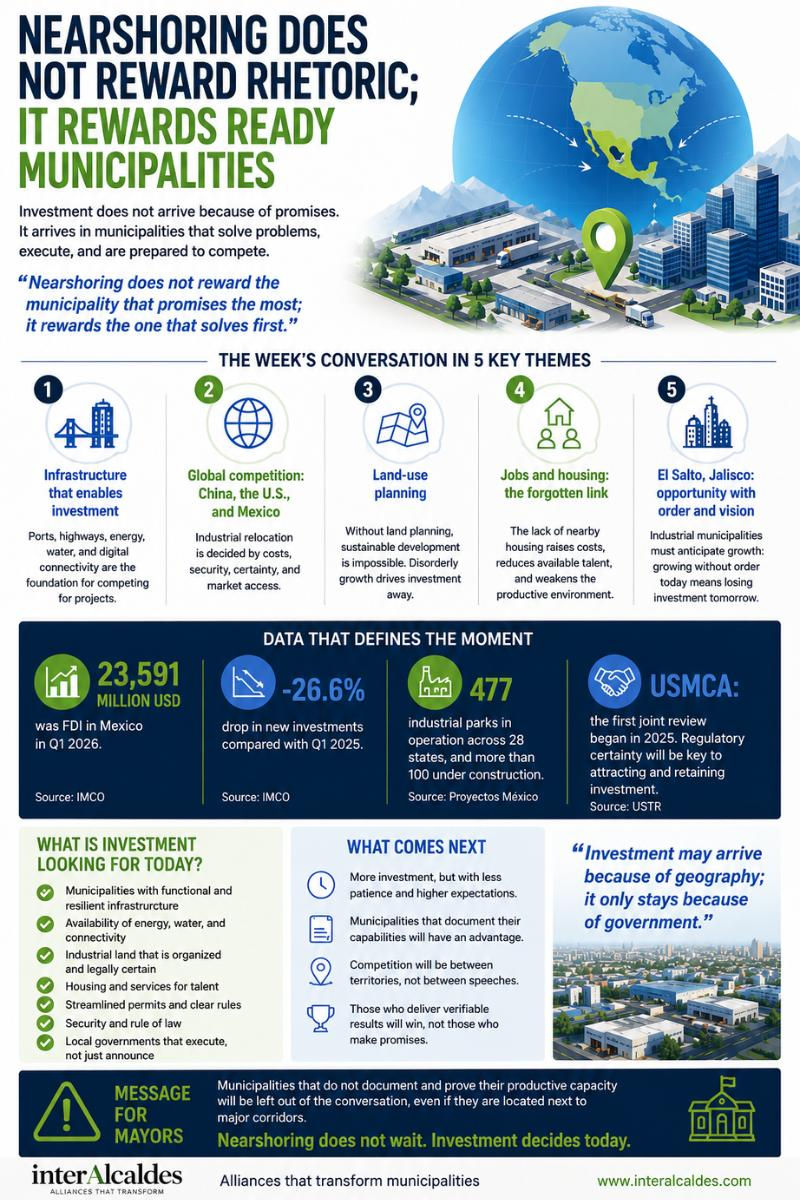
Nearshoring does not reward speeches because companies do not invest in enthusiasm. They invest in certainty, costs, timing, talent and execution. The political pressure on municipalities will become increasingly severe: those that cannot document their capacity will be left out of the productive conversation, even if they are close to strategic corridors, highways or attractive markets. Geography opens the door; municipal management decides whether that door stays open.
The question for Mexican municipalities is no longer whether they want to ride the wave, but whether they are ready to sustain it without breaking their territory. Which municipality can prove today, with data rather than promises, that it is prepared to receive investment without sacrificing quality of life?

Escrito por: Editorial
Sources consulted
IMCO. Inversión Extranjera Directa en México | Primer trimestre de 2026
Proyectos México / Banobras. Nearshoring - Relocalización
Proyectos México / Banobras. Nearshoring in Mexico
World Bank. Logistics Performance Indicators 2.0
El Economista. Industriales prevén nueva ola de nearshoring, pero alertan por rezagos en energía, agua y aduanas
UNCTAD. World Investment Report 2025: International investment in the digital economy



Comments