


Mirror Cities. The New Municipal Diplomacy That Will Define Mexico’s Economic Power
- Editorial

- Apr 13
- 4 min read
Updated: Apr 15

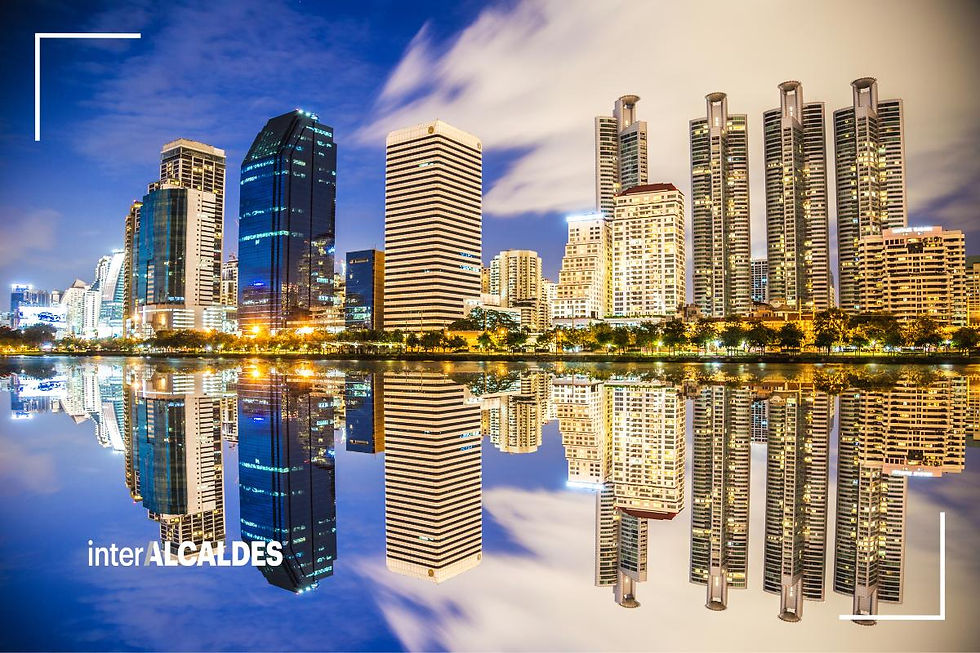
At a time when the global economy is reorganizing at an unprecedented pace, cities have ceased to be merely administrative centers and have become true nodes of economic, political, and strategic power. Today, development is no longer defined solely by national governments, but by the ability of municipalities, counties, and states to integrate into global networks of cooperation, competition, and innovation.
In this context, Mexico faces a silent yet decisive crossroads: continue operating under traditional local development frameworks or embrace the idea that the future is built on a comparative and international logic. It is here that a key concept begins to gain traction in strategic planning circles: mirror cities.
Talking about mirror cities is not a theoretical exercise nor an aspirational challenge. It is a concrete tool for analysis and action. It involves identifying cities around the world that share structural characteristics with Mexican municipalities—whether in size, economic vocation, geographic location, or urban challenges—and analyzing how they have addressed similar issues or capitalized on opportunities that are now within Mexico’s reach.
The premise is clear: no municipality competes in isolation. Every Mexican city already has, whether it acknowledges it or not, an international counterpart with which it competes for investment, talent, infrastructure, and geopolitical relevance.
You can listen to this article here:
Monterrey does not only compete with other cities in northern Mexico; it competes with industrial hubs such as Houston. Guadalajara is not limited to the national ecosystem; it effectively interacts with technology hubs like Austin. Mexico City, due to its scale and complexity, finds parallels with global capitals such as Madrid. And along the border, cities like Tijuana operate within a binational dynamic that inevitably links them to San Diego.
However, despite this reality, Mexico has not systematically built a framework that allows it to understand, measure, and leverage these mirror relationships. The lack of this perspective limits the ability of local governments to make informed decisions, design high-impact public policies, and, above all, communicate their potential to international stakeholders.
The relevance of this approach goes beyond comparative analysis. Recognizing mirror cities opens the door to a new form of diplomacy—a municipal diplomacy that does not rely exclusively on foreign ministries or formal treaties, but on the capacity of local governments to forge strategic alliances, exchange knowledge, and attract investment through a clear narrative of global positioning.
In this new scenario, mayors and governors are no longer merely administrators of territory; they become key players in the international economy. Their ability to understand what their mirror city is doing better—and how to adapt those solutions to the local context—can make the difference between stagnation and accelerated growth.

Yet this process also requires a shift in mindset. It is not about blindly replicating foreign models, but about translating lessons into viable solutions for the Mexican reality. Each city has its own identity, its own limitations, and its own opportunities. The value of the mirror concept lies precisely in its ability to provide strategic references, not rigid prescriptions.
In an environment shaped by phenomena such as nearshoring, supply chain relocation, digital transformation, and increasing pressure on urban resources, competition among cities will intensify. Those that manage to position themselves within international networks, understand their comparative advantages, and act with a global vision will be the ones to capture flows of capital, talent, and innovation in the years ahead.
For this reason, it is essential to begin building a structured framework that allows for the identification, analysis, and monitoring of these relationships. A tool that serves not only as an editorial reference, but also as a working instrument for governments, companies, and international organizations.
In this context, there is a clear need to promote an initiative that organizes this conversation and takes it to the next level: the interAlcaldes Mirror Cities Index. This index aims to map the strategic relationships between Mexican municipalities and their international counterparts, evaluating their level of development, key sectors, structural risks, and opportunities for cooperation. Beyond a ranking, it seeks to build a platform that articulates information, fosters dialogue, and drives decision-making. The objective is clear: to offer mayors, governors, investors, and opinion leaders a tool that enables them to understand where each Mexican city stands on the global stage—and where it can go.

This article marks the beginning of an editorial agenda that, in the coming weeks, will explore these connections in depth. Each analysis will aim not only to compare, but to propose. Not only to highlight gaps, but to identify pathways for action. Not only to observe the world, but to connect Mexico to it. Because in the new economy, the cities that understand who they are competing with… are the ones that ultimately lead. And Mexico, now more than ever, needs cities that think—and act—with a global vision.
At the close of this analysis, the conversation cannot remain on paper. At interAlcaldes, we understand that the best ideas emerge when they are tested against the real-world experience of those who govern, invest in, and transform cities every day. That is why we invite our readers—mayors, public officials, business leaders, academics, and citizens—to share their perspectives: Which city do you consider the true mirror of your municipality? What decisions are making the difference? Where are the opportunities we are still not seeing? Your insights not only enrich this discussion, but also help build a collective agenda that can redefine Mexico’s urban future.

Written by: Editorial


Comments