


European Regulation Is Redefining Global Trade—and Mexico Must Respond
- Editorial

- Apr 21
- 3 min read


European regulation is no longer a European issue. It is the new frontier of global trade.
For decades, the rules of international trade were defined by treaties, tariffs, and multilateral agreements. Today, that power is quietly shifting to another arena: regulation. And in that arena, the European Union has chosen to play in a different league. It does not compete on price. It competes on standards.
The result is a structural tension that Mexico has yet to fully grasp: anyone who wants to sell to the world will have to comply with Europe. It is not an option. It is a condition.
New European legislation in environmental, digital, and labor matters—from CBAM to supply chain regulations—is redefining how goods are produced, transported, and traded. More importantly, it is redefining who gets to participate.
“Europe no longer regulates its own market. It regulates global trade”
European Regulation and Global Trade, The New Silent Protectionism
International trade is entering a new phase. It is no longer about closing borders, but about raising requirements. According to the World Bank, more than 60% of global trade is already influenced by non-tariff measures, a trend that continues to intensify in 2026. CBAM will directly impact key industries such as steel, cement, and aluminum—sectors where Mexico has direct or indirect export exposure.
But the structural shift runs deeper: European regulation requires companies to track their entire value chain—from raw material origins to labor conditions. This fundamentally transforms the logic of trade.
You can listen to this article here:
“It is no longer enough to be competitive. You must be verifiable”
For Mexico, this creates a strategic crossroads: adapt to the new regulatory ecosystem or risk being pushed into lower-value markets.
Mexico Between Two Worlds, USMCA and Global Standards
Mexico faces a unique strategic paradox. On one hand, it is deeply integrated into the United States-Mexico-Canada Agreement, where an industrial, volume-driven logic dominates. On the other, Europe is imposing a model based on sustainability, traceability, and governance.
According to the OECD, more than 70% of Mexican exports are concentrated in North America, while Europe represents a high-value market with stricter regulatory demands. The risk is clear, Mexico may remain efficient at producing, but insufficient at complying. And in the new global trade environment, compliance is competition.
European companies are already transferring these requirements to suppliers across Latin America, Asia, and Africa. Even companies that do not export directly to Europe can be affected if they are part of global supply chains.
“Regulation travels faster than products”

Nearshoring and European Regulation, Mexico’s Strategic Opportunity
This is where a critical opportunity emerges—one that is still underappreciated. While some view regulation as a barrier, others are turning it into a competitive advantage. Countries like Chile and Vietnam are already aligning their production systems with European standards. Mexico holds a structural advantage, nearshoring.
If it can integrate European regulatory compliance with its North American positioning, it could become a strategic bridge between both economic blocs. According to the United Nations Conference on Trade and Development, investments in sustainable supply chains grew by more than 20% in 2025 and are expected to continue expanding in 2026. That capital is looking for destinations that comply. Not those that promise.
You can see this article here:
“Compliance is the new currency of global trade”
Municipalities and Global Competitiveness: Where Regulation Becomes Local
The biggest mistake would be to assume this phenomenon belongs only to federal governments or large corporations. European regulation has a direct local impact.
Industrial parks, water systems, energy infrastructure, logistics, and waste management are all becoming part of the global compliance equation.
An industrial park without environmental certifications can be excluded from European supply chains. A city without traceability loses competitiveness. A region without verifiable labor standards becomes ineligible. This redefines the role of Mexican municipalities. Attracting investment is no longer enough. It must be made viable under international standards.
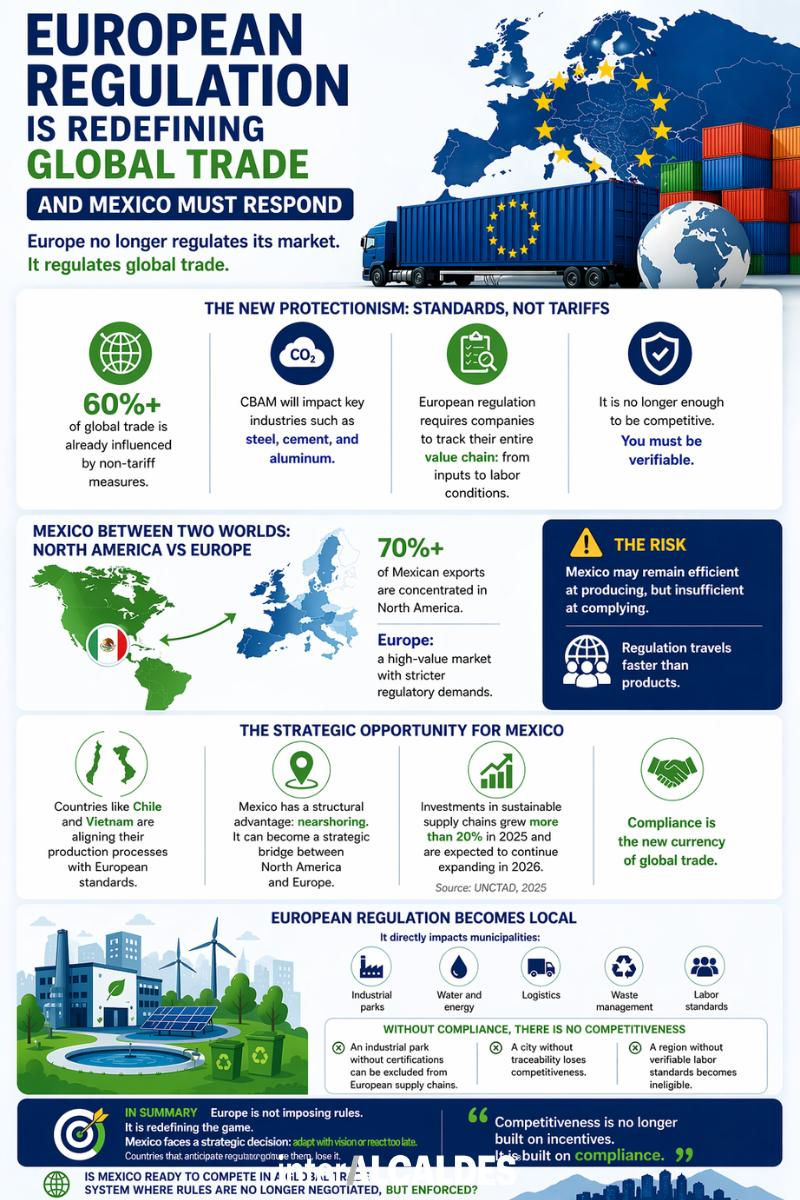
“Competitiveness is no longer built on incentives. It is built on compliance.”
Europe is not imposing rules. It is redefining the game.
And in this new landscape, Mexico faces a strategic decision, adapt with vision or react too late. Countries that anticipate regulatory change capture value. Those that ignore it lose it. At interAlcaldes, we will continue analyzing how these global dynamics impact Mexican cities, how local governments can become compliance hubs, and how Mexico can position itself within the new economic order. Because understanding the world is no longer enough. You must align with it.
Is Mexico ready to compete in a global trade system where rules are no longer negotiated—but enforced?

Written by: Editorial


Comments