


Women Mayors Rising. The New Local Power Reshaping the Global Economy
- Editorial

- Mar 11
- 4 min read

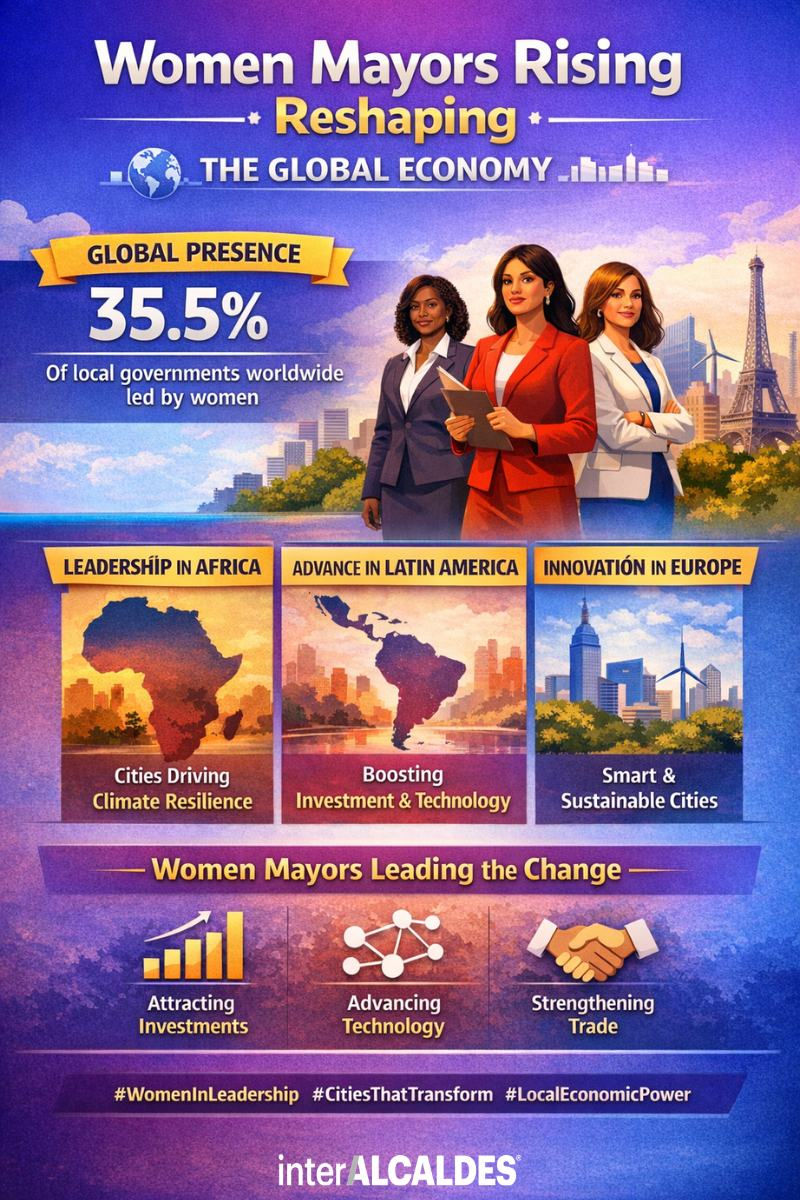
The conversation about female leadership no longer belongs solely to the agenda of rights and representation. Across municipalities in Africa, Latin America, and Europe, it is increasingly becoming a hard variable of competitiveness, governance, and innovation. The reason is simple: in a period marked by strained supply chains, the upcoming review of the USMCA, the energy transition, and accelerated digitalization, local power has returned to the center of economic decision-making. The authorities who manage water, mobility, permits, security, industrial land, and public services now determine much of the real investment on the ground. And although progress remains uneven, women mayors and municipal leaders are beginning to carry more weight than many national governments fully recognize. Globally, women represented about 35.5% of local government officials in recent international measurements, while only a small fraction of countries are led by women at the national level, a sign that the glass ceiling has not disappeared—it has simply moved higher.
For Mexico, this discussion matters more than it may appear. The country closed 2025 with exports surpassing 617 billion dollars and with bilateral trade with the United States reaching roughly 872 billion dollars, the largest commercial relationship either country maintains with a partner. Mexico also became the largest destination for U.S. exports, receiving more than 330 billion dollars in goods. In other words, competitiveness between both economies depends not only on Washington or Mexico City, but also on municipalities capable of delivering infrastructure, attracting talent, organizing urban land, and reducing regulatory friction. In that environment, female leadership at the local level stops being symbolic and becomes an economic asset.
Latin America illustrates a revealing paradox. The region has been a pioneer in parity laws and the visibility of women in politics, yet it still lags behind in local government leadership. International organizations report that roughly a quarter of local government positions in Latin America and the Caribbean are held by women, below the global average. Mexico reflects that tension. While female representation in national politics has expanded rapidly, the percentage of women leading municipalities remains considerably lower. The lesson is uncomfortable but important: legal parity does not yet guarantee effective territorial power.
Where women govern cities with executive vision, however, the results are beginning to reshape the debate. In Europe, Zaragoza’s mayor Natalia Chueca has positioned the Spanish city as a technological investment hub, promoting artificial intelligence, renewable energy, and data centers through partnerships with global investors and digital infrastructure initiatives. Barcelona recently announced a multi-year plan to expand artificial intelligence tools in public services, housing policy, and administrative management. The signal for Mexico is clear: the competition for global investment increasingly occurs between cities that combine technological governance with a strong international narrative.

Europe also offers a more complex lesson. The tenure of Paris mayor Anne Hidalgo illustrates the transformative power of city leadership capable of redesigning mobility, public space, and climate policy. Over the past few years, Paris expanded its cycling infrastructure dramatically and saw a surge in bicycle use following the pandemic. Yet the transformation has also generated debates about fiscal sustainability, metropolitan governance, and long-term financing. For cities seeking to replicate the image of the “green metropolis” without strengthening financial management and social consensus, the warning is evident.
Africa, meanwhile, is demonstrating that female municipal leadership can be especially valuable where climate pressure and fiscal fragility are most intense. In Freetown, Sierra Leone, Mayor Yvonne Aki-Sawyerr has gained international attention for urban reforestation programs and resilience strategies aimed at combating environmental degradation and landslide risks. At the same time, economic forecasts across the African continent show moderate growth amid global trade uncertainty. In that context, cities governed with a resilience and sustainability approach could become emerging nodes of technological cooperation, green investment, and subnational diplomacy. For Mexico, which is increasingly exploring economic ties with African markets while maintaining its North American anchor, these urban partnerships may open new opportunities.
Academic research from institutions in the United States and Mexico reinforces this perspective. Studies from organizations such as Brookings have noted that the effectiveness of policies supporting women’s economic participation in Mexico often depends on the vision and institutional capacity of local governments. Research from Mexican universities also warns that the rise of women to mayoral offices should not automatically be interpreted as substantive equality if they continue governing municipalities with limited budgets, higher security risks, or restricted political autonomy. In other words, measuring progress requires more than counting female leaders; it requires evaluating budgets, authority, safety conditions, and technological capacity.
The challenge moving forward is not only electing more women, but building municipalities where their leadership can scale and endure. That means protecting women leaders from political violence, professionalizing municipal administrations, expanding financing for digital and climate infrastructure, and strengthening cooperation between cities, universities, development banks, and global value chains. It also means abandoning a symbolic view of female leadership. In the economy that is emerging, cities that negotiate data, logistics, water, energy, land, and talent most effectively will capture the next wave of investment.
If Mexico aims to approach the upcoming review of the USMCA with strength, modernize its trade agreements with Europe, and expand cooperation with Africa, it will need more women successfully leading at the local level—not merely appearing in the photograph of political representation, but shaping the operational foundations of economic growth.

Written by: Editorial


Comments