


The Button That Shuts Down the System. Automation That Promises Progress but Could Leave Mexico at a Standstill
- Víctor Jesús Hernández Salinas

- Apr 13
- 4 min read
Updated: Apr 15

Full credit for the article and core ideas: Víctor Jesús Hernández Salinas. Editorial adaptation for interAlcaldes based on his text “The Paradox of Automation.”

The great promise of automation was simple, produce more, decide faster, and reduce errors. But Víctor Jesús Hernández Salinas’ warning is more uncomfortable—and precisely for that reason, more valuable, the more we delegate critical functions to digital systems, the more fragile our institutions can become when technology fails. In his article, the author presents a paradox that no longer belongs to theory but to operational security, a hyperconnected society can, at the same time, be a society less capable of reacting on its own when the digital layer collapses.
This argument directly connects with the interAlcaldes agenda. For a municipality, a public hospital, a treasury office, a water network, a C5 center, or a public service platform, automation does not only represent efficiency—it also redefines political risk. When a centralized system concentrates records, payments, monitoring, surveillance, and operational coordination, failure is no longer technical; it becomes institutional. The World Economic Forum warned in its Global Cybersecurity Outlook 2026 that in Latin America and the Caribbean, only 13% of respondents feel confident in national preparedness to respond to cyberattacks on critical infrastructure, while 23% of public sector organizations report insufficient cyber resilience capabilities.
You can listen to this article here:
Víctor Jesús Hernández Salinas’ concept of the “black box” also deserves to be read through the lens of public service. It is not enough to have sophisticated systems if fewer and fewer people understand their logic, their limits, and their emergency protocols. The problem is not the use of technology; the problem is turning it into a substitute for human judgment, operational memory, and manual expertise. This erosion of “know-how” is especially delicate in local governments, where service continuity often depends on small teams, high administrative turnover, and limited budgets. MIT has emphasized this year that the new industrial model cannot be reduced to product innovation; it must be designed with resilience, flexibility, maintenance, and the valuing of knowledge at every level of work.
The economic context makes this discussion even more urgent. The IMF estimates that nearly 40% of jobs worldwide are exposed to transformations driven by AI, noting that demand for new skills is already reshaping wages, hiring, and productivity. At the same time, the OECD projects Mexico will grow by 1.4% this year, while the IMF places Mexican expansion at around 1.5%. In other words, moderate growth that forces productivity gains without sacrificing resilience.
This is where the bilateral and global dimension emerges. Mexico is not only automating to compete locally, but to sustain its place within production chains that cross North America and connect with Europe, Asia, Africa, and other strategic markets. Brookings documented that Mexico closed 2025 as the United States’ main trading partner, with $873 billion in bilateral trade, equivalent to 15.6% of total U.S. goods trade. Additionally, compliance with USMCA rules in Mexican exports to the United States rose from less than half to nearly 80% of total trade value in 2025—a sign of deeper integration, but also greater systemic dependence.

In other words, when Mexico automates ports, customs, advanced manufacturing, logistics, healthcare, or financial services, it is not only seeking domestic efficiency—it is defending its position in a global competition shaped by trade tensions, supply chain reconfiguration, and technological pressure. The U.S. Census Bureau confirms that Mexico remained among its top trading partners at the start of 2026, while recent studies highlight that Mexican manufacturing is beginning to benefit from U.S. demand linked to artificial intelligence development, particularly in computing equipment, communications, and electronic accessories.
But progress comes at a cost. In Mexico, annual inflation reached 4.59% in March, and the central bank maintains its benchmark rate at 6.75%—signals of an economy that must modernize without losing its ability to respond to external shocks. At the same time, AI adoption is no longer marginal. According to UNAM’s Gaceta, 77% of companies use or explore AI, 58% already employ generative AI for content or customer service, and 60% of workers use it in daily tasks. The issue, as the original text warned, is not that technology is everywhere, but that it is advancing faster than training, governance, and operational culture.
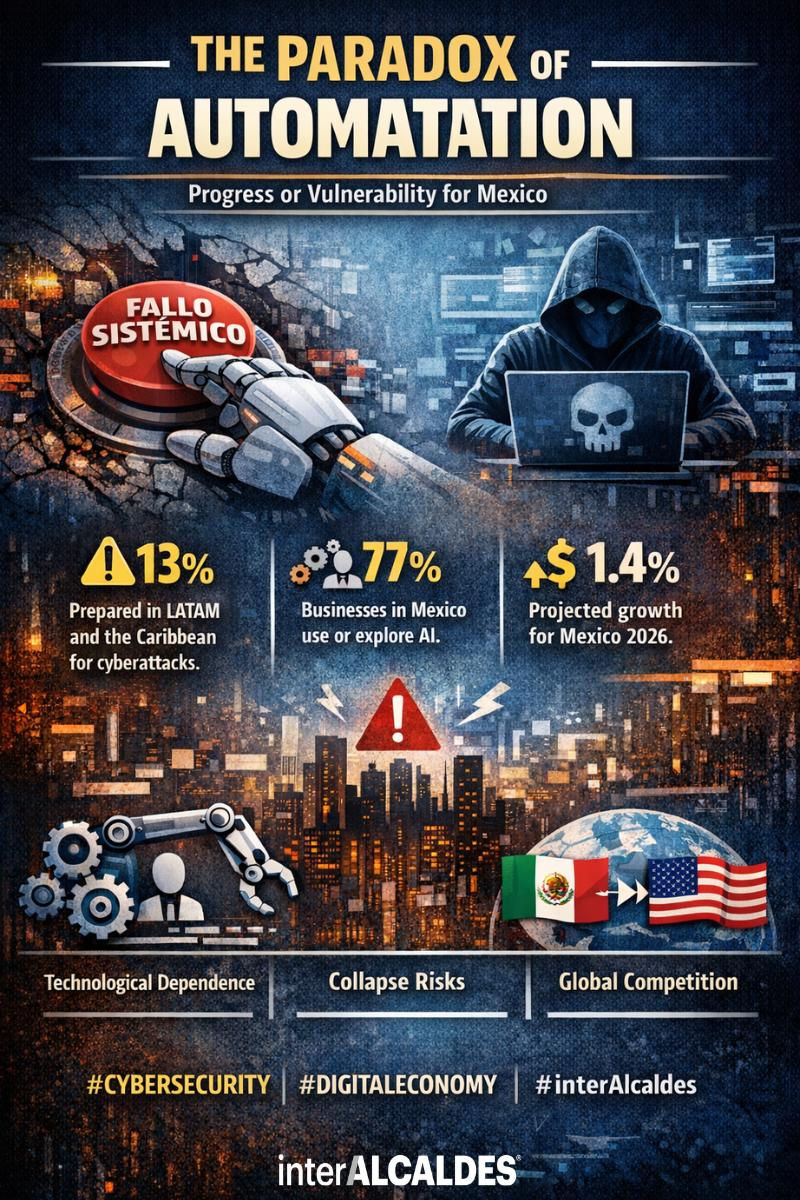
The greatest challenge ahead will not be choosing whether to automate. That debate is already behind us. The real challenge will be building hybrid resilience, robust digital systems, but also manual protocols; technical talent capable of intervening without interfaces; cybersecurity with a territorial focus; and authorities that understand that technological sovereignty also means operational continuity. The International AI Safety Report 2026 insists that AI safety depends on institutional readiness, international cooperation, and rules that accompany innovation rather than chase it too late. For Mexico, this means professionalizing local governments, protecting critical infrastructure, and developing teams that not only know how to use platforms, but can sustain essential services when the screen goes dark.
At interAlcaldes, we want to hear your perspective. Is automation truly strengthening municipalities and institutions, or is it making them more dependent and vulnerable? Share your thoughts and join a serious conversation about technology, operational sovereignty, and the future of public systems.
The full article is available at:


Comments