


South America Accelerates. The Green Corridors That Could Redraw Mexico’s Trade with Europe and Africa
- Editorial

- Mar 13
- 5 min read

The discussion about green corridors and sustainable logistics in South America has moved beyond environmental rhetoric and into a hard competition for competitiveness, geopolitical influence, and control of supply chains. What is at stake is not only how goods move with fewer emissions, but who will capture the value of the next phase of trade between the Americas, Europe, and Africa. For Mexico—whose trade with the United States reached more than $872 billion in 2025 and remains deeply tied to North American logistics—the signal from South America is clear: the future of trade will be more regional, more multimodal, and far more demanding in terms of carbon footprint.
South America is advancing in that direction through a mix of ports, clean energy, digitalization, and geopolitical repositioning. One of the most visible examples emerged in late January, when the ports of Santos in Brazil and Valencia in Spain signed a memorandum to establish a maritime green corridor between Europe and South America. The agreement goes beyond symbolic cooperation. It includes the use of low- or zero-emission fuels, shore-side electricity for ships in port, electrification of terminals, and efficiency improvements through digital logistics technologies. The political message is powerful: sustainability is no longer negotiated at the margins of transatlantic trade; it is becoming part of its core infrastructure.
That development matters for Mexico for a practical reason. While the USMCA protects a large portion of Mexico’s trade with the United States, it also exposes the country to stricter rules of origin, compliance requirements, and political reviews of supply chains. At the same time, recent trade data shows a strong signal of diversification: Mexican non-oil exports to the United States grew about 7.9 percent year over year early in the year, while exports to the rest of the world expanded nearly 19.6 percent. The implication is clear. Diversification is no longer a policy slogan—it is becoming an operational necessity. If South America successfully connects low-carbon corridors to Europe and eventually to the South Atlantic and Africa, Mexico will face a new type of competition: not just for costs, but for green credentials and logistics efficiency.
The progress seen across the region shows how quickly the strategic map is shifting. The Bioceanic Corridor connecting Brazil, Paraguay, Argentina, and Chile is now widely viewed by international institutions as a platform for continental integration. OECD research suggests that improved connectivity along this route could reduce cargo transport costs by as much as 30 to 40 percent and shorten shipping times by up to fifteen days. The corridor spans more than 2,300 miles, linking the Atlantic with Chilean Pacific ports such as Antofagasta, Iquique, and Mejillones. In effect, South America is constructing a physical and regulatory shortcut to reposition itself in trade flows with Asia, Europe, and Africa.

Technology and logistics infrastructure are also evolving rapidly. A new direct shipping route between Guangzhou in China and the port of Chancay in Peru is expected to reduce logistics costs by roughly 20 percent while accelerating connections to ports such as Manzanillo in Mexico and San Antonio in Chile. Beyond the Chinese component, the underlying lesson is broader: sustainable trade corridors depend on deep-water ports, digital logistics systems, and strong regional distribution networks. Chancay is already operating as a redistribution hub for hybrid and electric vehicles moving toward Chile, Ecuador, and Colombia—an early sign of how future low-carbon supply chains may function.
Energy is the structural foundation behind these changes. Across Latin America, investment in clean energy has increased by nearly 25 percent since 2015 and reached roughly $70 billion in 2025. The region now generates about 60 percent of its electricity from clean sources—approximately twice the global average. This advantage is critical. Without relatively clean electricity, electrified ports, hydrogen projects, and low-carbon freight networks remain little more than marketing. With it, they become part of a viable industrial strategy. Chile, for example, has approached months in which renewable sources account for nearly 70 percent of power generation, while Brazil is advancing large-scale e-fuel projects such as the HIF Global facility in the port of Açu, where each module is expected to produce around 220,000 tons of synthetic methanol annually for clean fuels.
Universities are increasingly framing this transition as a competitiveness challenge rather than simply a climate issue. Research from the Massachusetts Institute of Technology notes that a viable green corridor must combine significant decarbonization with tangible economic benefits. From Mexico, researchers at the National Autonomous University of Mexico highlight a structural challenge: Latin America remains heavily dependent on road transport. Between 2019 and 2021, approximately 85 percent of freight in the region moved by road, and freight transport accounts for a large share of logistics emissions. This explains why the competition will not be decided solely in ports. Railways, last-mile distribution systems, customs digitalization, traceability software, and financing structures will all determine whether green corridors actually function.
For Europe, the incentive is both regulatory and commercial: decarbonizing transport routes before new climate policies increase the cost of carbon-intensive supply chains. For Africa, the opportunity lies in a more connected South Atlantic and in emerging partnerships with Brazil and other South American economies. International organizations already identify future logistics corridors linking South America with African markets as part of a broader South-South trade strategy. For Mexico, the message is both uncomfortable and instructive. If South America advances more quickly in integrating clean energy, multimodal infrastructure, and geopolitical trade narratives, it could capture market space where Mexico’s advantage has traditionally depended on proximity to the United States.
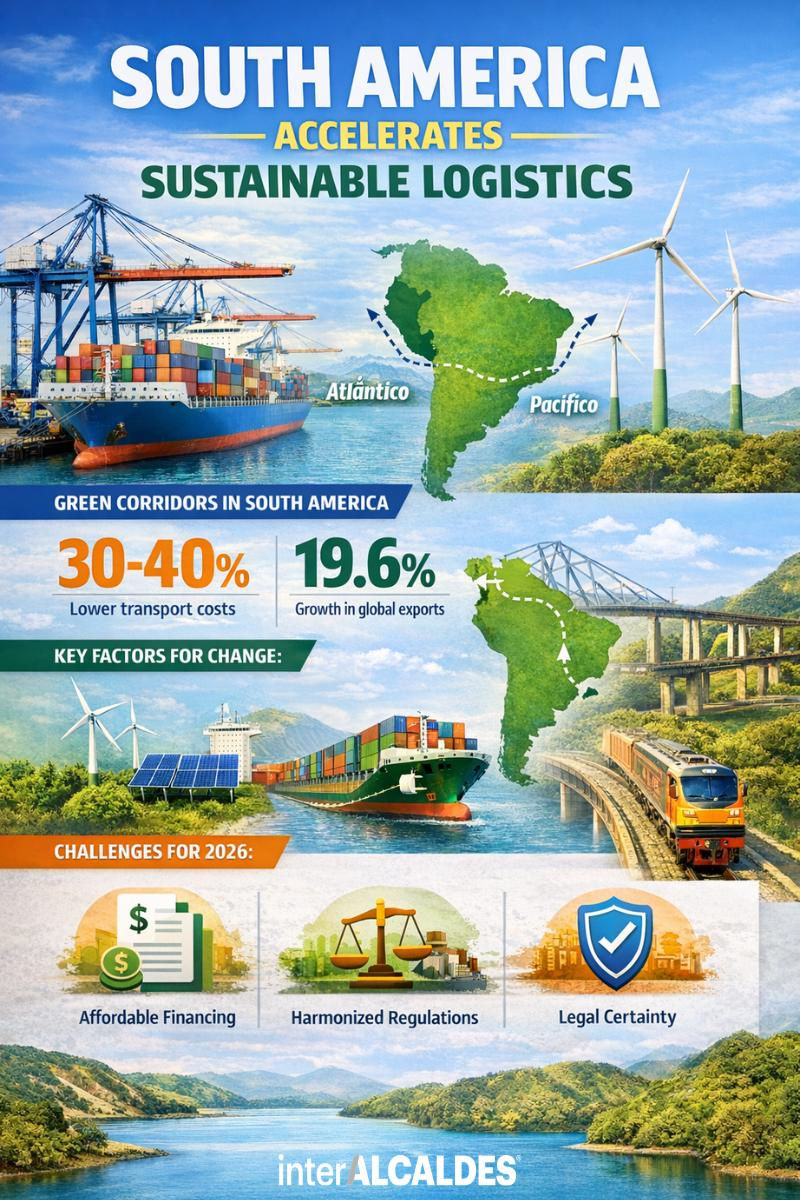
The greatest challenge for the region moving forward is not technological but institutional. South America will need cheaper financing, harmonized regulations, interoperable customs systems, legal certainty for investors, and strong subnational governments capable of executing large-scale infrastructure projects. Latin America currently attracts only about 5 percent of global private investment in clean energy and invests roughly 3 percent of its GDP in energy infrastructure, compared with about 5 percent in Europe, Asia, the Middle East, and North Africa. If that gap persists, green corridors risk remaining impressive maps and diplomatic announcements rather than operational trade routes.
But if ports such as Santos and Chancay, together with the Bioceanic Corridor and new transatlantic links, successfully consolidate, South America could do more than move goods with fewer emissions. It could shift the center of gravity of hemispheric trade. At that point, Mexico will face a strategic choice: compete merely as the low-cost neighbor of the United States, or evolve into a clean logistics power with truly transcontinental reach.
At interAlcaldes we want to hear your perspective: can Mexico and South America build a complementary green logistics agenda, or will they ultimately compete for the same routes and investments? Leave your comments and join the conversation.

Written by: Editorial


Comments