


Money Under the Microscope. Gender-Lens Financing That Can Win the New Economy
- Editorial

- Mar 27
- 3 min read

In 2026, international financing with a gender lens has stopped being a “corporate social responsibility” topic and become a hard lever of competitiveness. The reason is pragmatic: capital markets, development banks, and large investors are rewarding projects that measure impact, reduce risk, and raise productivity. Few agendas deliver returns as clearly as those that close gaps in labor participation, access to credit, and women’s economic security—especially in the places where growth is decided: municipalities, industrial zones, and logistics corridors that power trade with the United States and with partners across the Americas, Europe, and Africa.
The size of the problem explains why money is changing its rules. In emerging markets, women-led small and medium-sized enterprises face an estimated credit gap of US$1.4–1.7 trillion; paradoxically, financial institutions report that default rates among women borrowers are 53% lower than among men. This data dismantles the myth of “higher risk” and confirms that the obstacle is structural, not financial. Closing that bottleneck has macro effects: narrowing the credit gap for these firms could lift average annual revenues by about 12% by 2030 in emerging markets.

Mexico entered 2026 with instruments that place it squarely in this global conversation—but with a key challenge: moving the gender lens from rhetoric to financial architecture. In 2025, the Ministry of Finance integrated gender objectives into its sustainable finance framework through eligible expenditures and impact reporting. Its 2025 Sustainable Finance Strategy included 45 budget programs (social and green) with an approved budget of roughly MXN 466 billionas a base for mobilization and traceability. In parallel, the sovereign framework and reporting have continued to incorporate taxonomy and measurement tools that link spending to outcomes, including equality goals.
Internationally, the trend is not marginal. Labeled capital—green, social, sustainable, and sustainability-linked bonds—has expanded across Latin America and the Caribbean, evolving into structures designed for more demanding investors. At the same time, initiatives such as the 2X Challenge, backed by development finance institutions, demonstrate scale, reporting US$33.6 billion mobilized under gender-lens criteria. This matters for Mexico because it reshapes investor appetite in New York, Toronto, London, and Madrid: municipalities that present bankable projects with gender metrics can access cheaper or more stable capital; those that do not compete at a disadvantage.

The key point is that a gender lens should not be confined to “women’s programs.” It must operate as a financial model with three engines. The first is project design: care infrastructure, safe mobility, water and sanitation with access-and-time components, digitalized services, and training linked to formal employment. The second is risk structuring: guarantees, blended finance, performance incentives, and technical assistance that bring commercial banks into segments they previously avoided. The third is measurement: verifiable indicators that translate equality into productivity, revenue, and employability—because that is what markets buy.
The most important advance in 2025 was that the “how to finance” question stopped being improvised. Mexico is now debating and publishing frameworks to redirect capital toward sustainability and inclusion with explicit ambitions to mobilize resources. The country’s sustainable financing mobilization strategy quantifies gaps and needs through 2030, setting a national challenge at scale. In 2026, the next step is to municipalize this logic: turn local agendas into investment pipelines aligned with international standards so that trade partners—first the United States, but also Europe and the Global South—see Mexican municipalities as reliable counterparts for production chains, tourism, services, and technology.
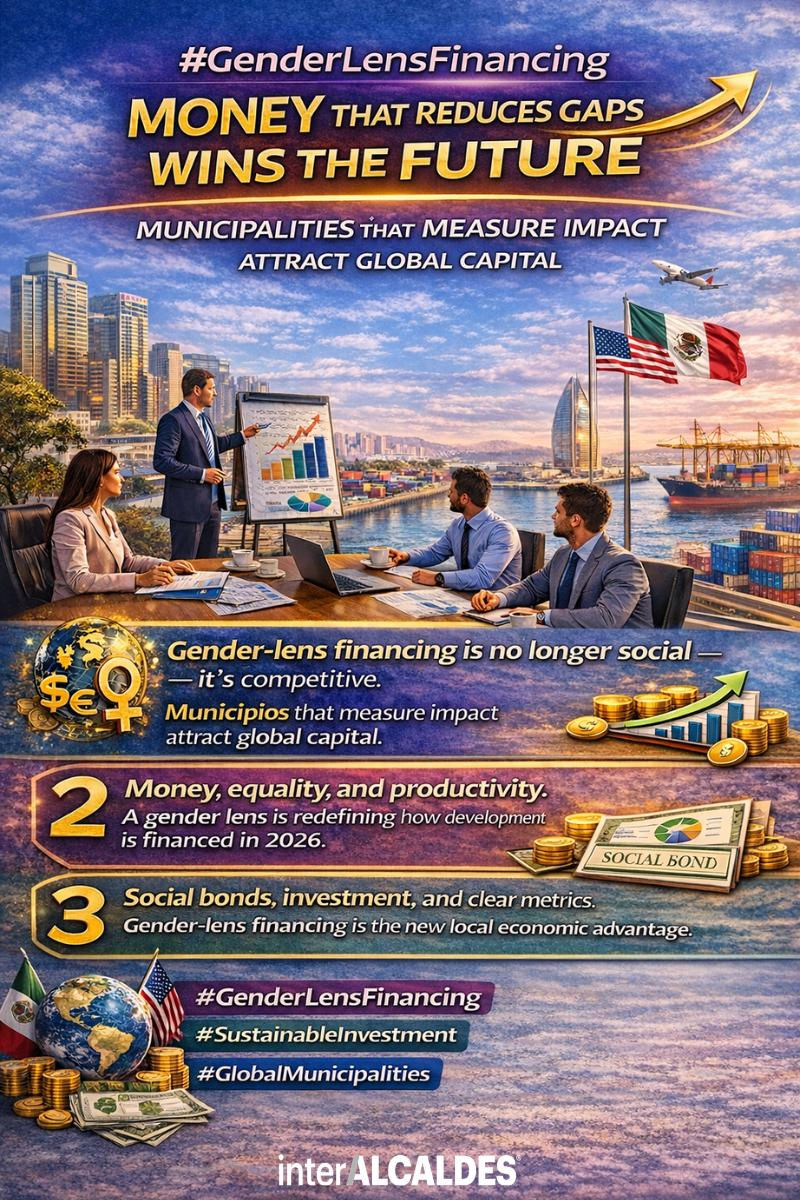
The challenges to unlock this potential in 2026 are concrete. First, local technical capacity: without municipal units able to structure projects, cost them, ensure transparency, and report impact, gender-lens capital remains at the federal or multilateral level. Second, integrity: without traceable procurement, auditing, and conflict-of-interest controls, no social bond survives scrutiny. Third, credible measurement: markets penalize cosmetic metrics; they demand evidence and continuity. Fourth, private-sector coordination: value chains and formal employment require partnerships with firms, chambers, and universities. Fifth, geopolitics: amid a more volatile trade environment, Mexico must use gender-lens financing as a reputational and productive advantage—not as a label.
In short, in 2026 gender-lens financing is the new test of institutional maturity. Municipalities that understand it first will not only close gaps—they will attract capital, talent, and projects.

Written by: Editorial


Comments